A Journey through the Economy of Colonial India
A Review of Tirthanker Roy’s The Economic History of India, 1857-2010
Subscribe on Substack, via RSS/Atom, or follow me on Twitter for updates
Sometime in the last year I came across the economic historian Tirthanker Roy on Twitter. I was intrigued by his arguments, often using economic data, that countered the popular narratives around colonial India (it became poorer during colonialism, it was deindustrialised, it was drained of wealth). And so I began reading various papers and book chapters on the economic history of India and eventually came across Roy’s outstanding book, The Economic History of India: 1857-2010.1
The book is a thorough and yet concise explanatory history of the general economic trends in British India, the princely states, and independent India. Its use of economic data creates a compelling and realistic picture of the many opposing forces at play during the period. We see how parts of the economy changed through a mix of forces, some of which grew the economy and others stagnated it. We also see how the motivations behind the colonial government are not black and white, neither entirely malevolent nor entirely benevolent. This is a book worth reading for anyone who is actually interested in an evidence based account of the 170 or so years of the Indian economy.
Although the book is structured around seven questions that are answered across thirteen chapters, there is one question that animates most of it and, I believe, will interest most ordinary readers: “Why did colonialism and globalisation generate inequality?” That is to say, why did colonial governance and integration into the world market generate unequal growth in the Indian economy? To answer this initial question, Roy begins with setting the scene of how the Indian economy transitioned from the pre-colonial period of the East India Company (1757-1857), to the colonial period (1857-1947) where the British government directly ruled 60-55% of the territory alongside the internally autonomous princely states.
The Transition to Colonial Governance
As Roy lays it out, the Mughal Empire at the beginning of the 18th century was fragmenting. It was strongest on the Indo-Gangetic plains with its perennial rivers for agriculture; it was weaker on the Deccan Plateau, where agriculture was threatened by harvest failures and famines, and the seaboard which was involved in maritime trade.
The largely agrarian and, importantly, feudal economy of the Mughal empire was structured within a tripartite property and tax regime. With the main tax being a land tax on the production of agricultural land, peasants held rights to cultivate the land, landlords held the right to tax the cultivators, and kings, warlords or military commanders held the right to grant landlords their rights (Roy, 21). This system of taxation had two consequences: 1) Due to the low productivity of land, taxes were a heavy burden on cultivators. 2) The conflicting interests of the cultivators and the landlords meant that land sales were rare and private investment into agriculture was low. The main way growth happened in agriculture was the enclosure of more land for cultivation. This is not to say industry did not exist. Rural industry, which involved “basic textiles, pottery, agricultural implements, sugar, leather, and oil”, was dispersed and low value, usually involving part-time workers (Roy, 23). Urban industry, which involved “finer textiles, carpets and shawls, decorative metalware and pottery, wood and ivory carving, and manufacture of arms and musical instruments” was more high quality and produced in factories (Roy, 23).
Unfortunately, Roy does not offer much data to help describe the state of the economy in the Indian subcontinent in the early 18th century. It is hard to tell where the pre-colonial economy stood in comparison to the rest of the world. So what was the economy like for most people before the rise of colonialism?
A fact that gets a lot of attention in the public discourse is that the regions comprising modern India accounted for 20-25% of world GDP before 1700.2 From this, people leap to the conclusion that India was very wealthy and had high living standards compared to Europe.3 For example, consider Shahi Tharoor, a member of India’s Parliament:
British rule in India is a stark example of the destructive impact of colonial greed. India was a thriving economy prior to its colonization by Britain, contributing 27% of global GDP in 1700. Post two centuries of exploitation by the British, India’s contribution to the global economy drastically reduced to 3%.4
While this story is heart stirring, without adjustments for income levels, population, and purchasing power, none of it tells us anything about living standards.
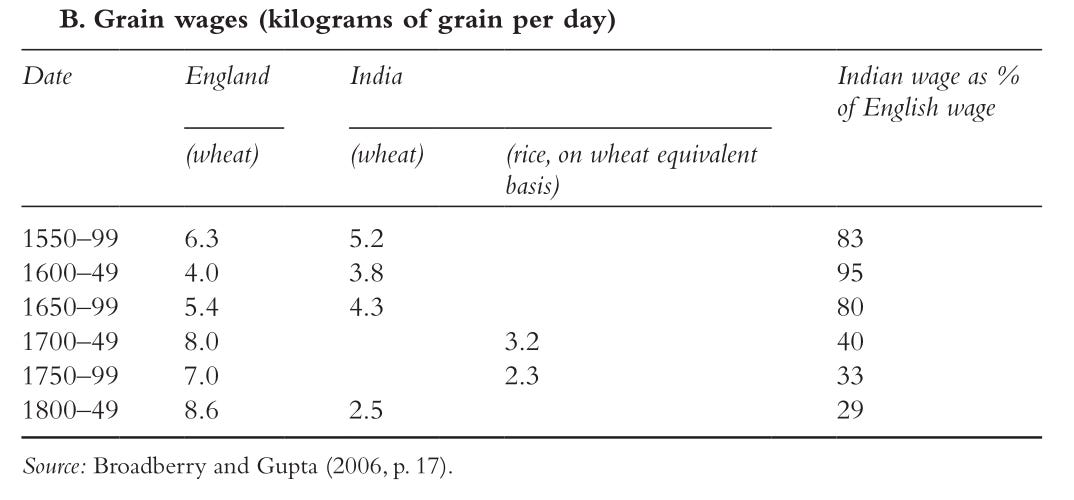
In Stephen Broadberry and Bishnupriya Gupta’s chapter in A New Economic History of India, they show trends in living standards from 1600 to 2000 by reconstructing wage data. I found this astounding, as it cuts through any possible biases of qualitative sources like travelogues by Europeans of the Indian sub-continent. So what did they find? When looking at a straight conversion of wages to silver, in India and Britain, Indian wages are roughly only a quarter of the British wage for an unskilled labourer before 1700 (Broadberry and Gupta 2016, 19).5 When these wages are adjusted for purchasing power the silver wage is deflated by the price of grain. Here they show the Indian wages roughly 80-90% of the British wage up until 1700, and then steeply declining through the Company Era from the middle of the 18th century up to the start of the colonial period in the middle of the 19th century.
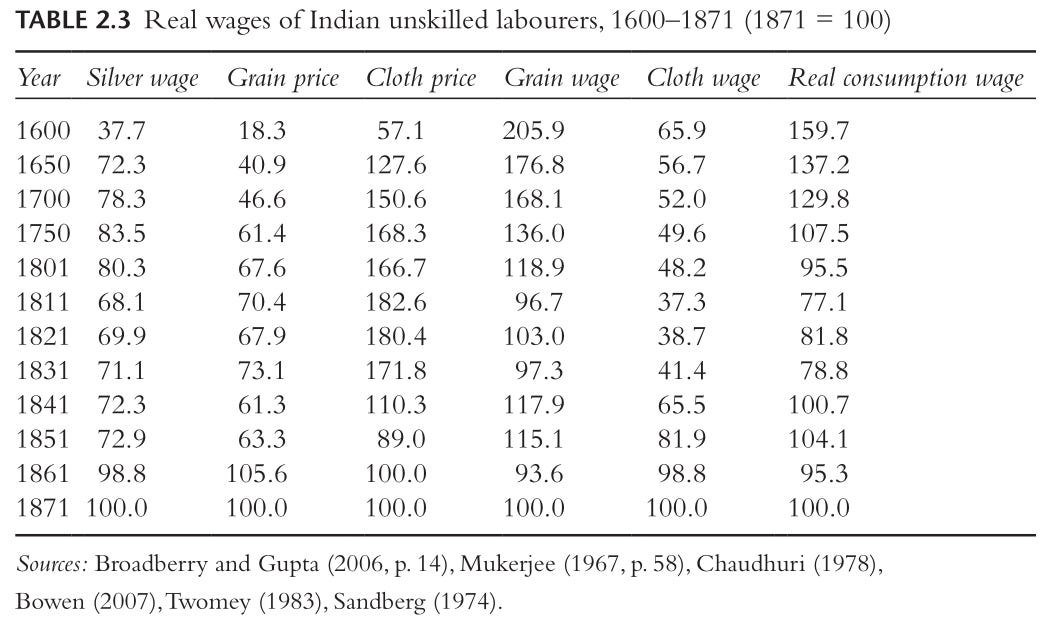
This picture of declining living standards in India is also seen in the real consumption wage that the authors construct with a weighted average of the grain wage (two-thirds) and cloth wage (one third). The real consumption wage holds roughly steady until 1700, after which it declines until the rise of the British East India Company in the 1750s, through to the 1840s where wages rise slightly back to where they were in 1750.
To get a broader picture of the economy, the authors also construct a GDP per capita index from 1600 to 1871 using population data, the wage and price data for cloth and grain, data from European East India companies for export industries, and tax revenue data for the government sector.
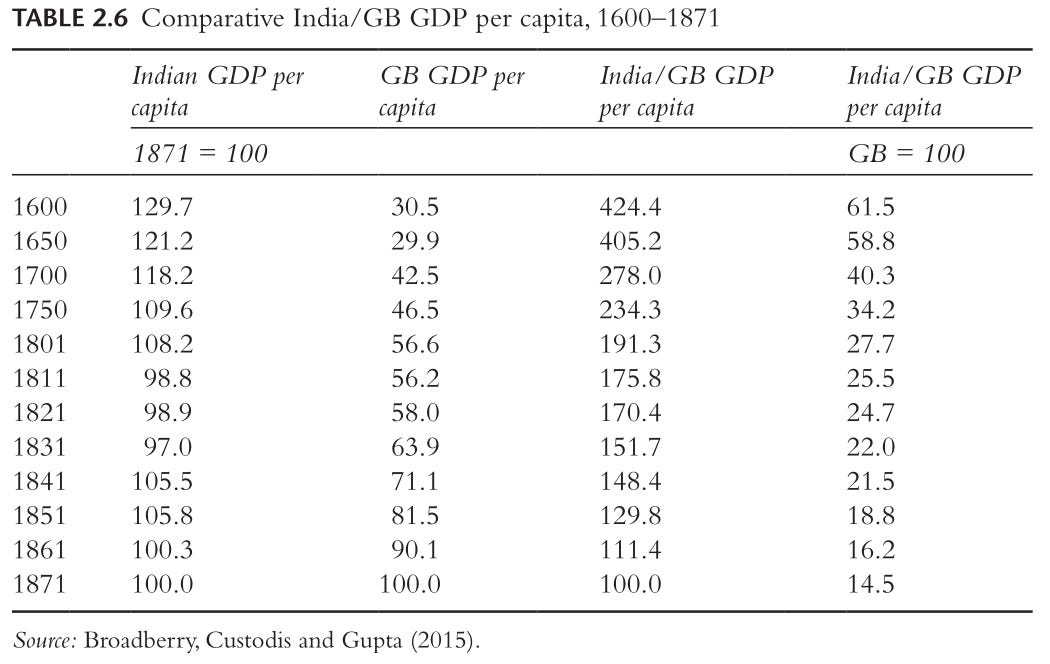
The reconstructed GDP per capita numbers show that India had only 60% of Great Britain’s GDP per capita in 1600. This steadily declined even before the East India Company took over in the 1750s and continued to decline all the way to 1871. This picture of living standards in India is confirmed by qualitative sources that describe how although pockets of immense wealth existed in India before the colonial period, the vast majority lived in poverty (Broadberry and Gupta 2016, 16-17).
What explains this divergence in living standards with Europe before and during the pre-colonial period? Broadberry and Gupta (2016, 25) point to low productivity in agriculture not keeping up with population growth. Roy (22) points to a similar cause with the land tax, which was the main source of revenue for the Mughals. Roy argues that due to agriculture’s dependence on monsoon rains it was low productivity. Therefore, the tax became a heavy burden on peasants which discouraged private investment (Roy, 20). In addition, the Mughal Empire was not a maritime power and so was not much interested in seaborne trade and lost out on its potential revenues.
For Roy, these explanations provide an insight into what kind of government colonial governance was from an economic perspective. It was a qualitatively different type of governance to what existed before. In the first instance it was not feudal. The British East India Company was a commercial venture that entered politics as a way to secure relationships with Indians they depended on and to lower the risk on dangerous inland trade routes. It expanded its territory in the 18th century through direct conquests, and by receiving territory as payment for services to local rulers. It was successful on the battlefield because it fielded a standing army as opposed to the Indian states that relied on feudal relationships to raise soldiers. This ultimately allowed them to both ally with and fight against Indian rulers and the other European powers.
This shift away from feudal governance continued with the way the Company reformed property rights to emphasise the right of ownership in the hope it would increase land sales and productivity (Roy, 35). Overall the extent to which it caused this is hard to assess with a lack of data. However, Roy does argue that it allowed them to tax more efficiently and so raise state revenues needed for public works. As Roy (54) says of Bengal, “revenue per square mile increased from Rs 236 in 1763, to 520 in 1817, and further to 724 in 1853.”
The second way colonial governance was different from the Mughal empire, was that it was mercantile and so it emphasised trade and started the process of globalisation. With the rise of the Company as a political player, Roy claims that trade, foreign and domestic, increased. The only real data point Roy (42) offers for this is that “The average annual growth rate of trade was 4–5 per cent during 1834–1913,” so it is hard to gauge how significant it was. Nevertheless, as Roy (42) explains it, domestic trade in grain increased with the development of coastal routes and overland routes connecting new production centres. Foreign trade began to diversify into “indigo, opium, silk, tobacco, and cotton, and to a more limited extent, salt, sugar, and saltpetre,” as India lost its export market for textiles with the rise of modern industries in England making imports cheaper.
Roy (52) argues that although there were job losses due to these imports, in the case of Bengal they were about 4 per cent over several decades and so hardly a form of catastrophic deindustrialisation, and in the case of India as a whole there is no data on the full size of the labour force. Moreover, Roy points out the jobs lost were likely low productivity as they were done by people in the home in their spare time. With cheaper imports these hand spinners would have been able to afford more yarn and cloth. The evidence on the iron and steel industry is also uncertain. The end of the Company’s monopoly on trade in 1813 encouraged investment in India into iron and steel. Import of iron and steel goods increased from the late 18th century, but it was for goods that were not made on a large-scale by Indian industry. Overall the effect of the industrial revolution in Europe on Indian workers in textiles, and iron and steel is uncertain.
Although this part of the book is light on any specific economic data, reading Roy’s account of the rise of the Company makes one appreciate how different colonial governance was. It was a commercial enterprise which, through alliances, direct conquest, and land purchases, initiated a revolution of the existing legal order. It started the process of establishing a distinctly new form of governance for the region and integrating it into world markets.
The Colonial Period: Agriculture and the Rest
The bulk of the book deals with Roy’s explanation of how exactly colonial governance and globalisation generated unequal growth from 1857 to 1947. Roy sums up the macroeconomic situation of India through the lens of gross national income (GDP, net overseas income, and taxes) in the following striking way:
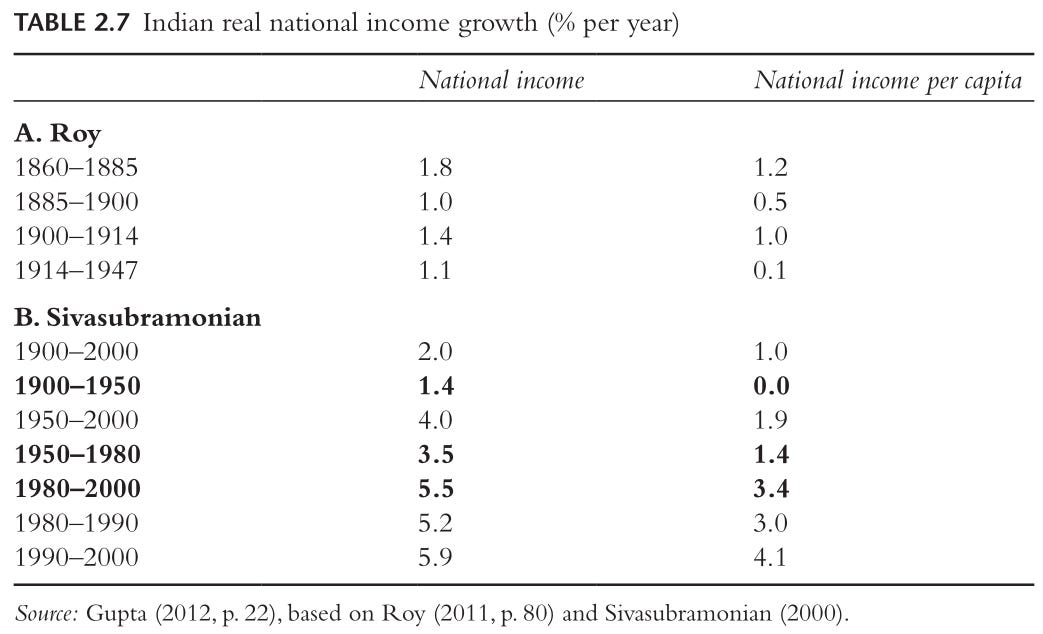
“Between 1866 and 1914, the growth rates of total income and average income were positive and attained respectable levels by international comparison. Between 1914 and 1947, national income grew at approximately 1 per cent per year, which rate, when adjusted for rising population growth, yielded a near-zero rate of growth of average income.”(67)
This offers quite a bleak picture of the Indian economy through the colonial period: that the economy grew in the pre-war period up to 1914 and then stagnated in the post-war period after the first world war. This is largely confirmed by Broadberry and Gupta’s data as well. While there was growth in the national income per capita from the onset of the British Raj until World War I, living standards after that stagnated until 1950.
So what explains the trend of living standards growing initially during the colonial period and then stagnating? The following two tables by Roy (71) are a guide in that they show that the main area of economic activity was in agriculture. Agriculture was significant in its share of national income at 40-50% through the first half of the 20th century, and was even more significant in the share of employment with almost 75% of the workforce.
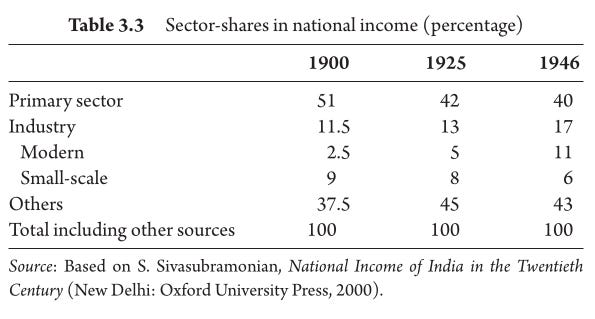
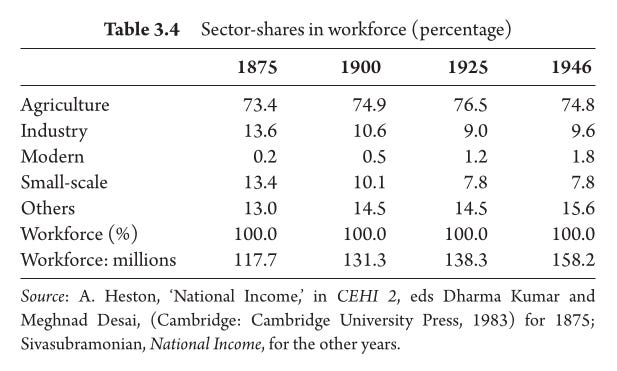
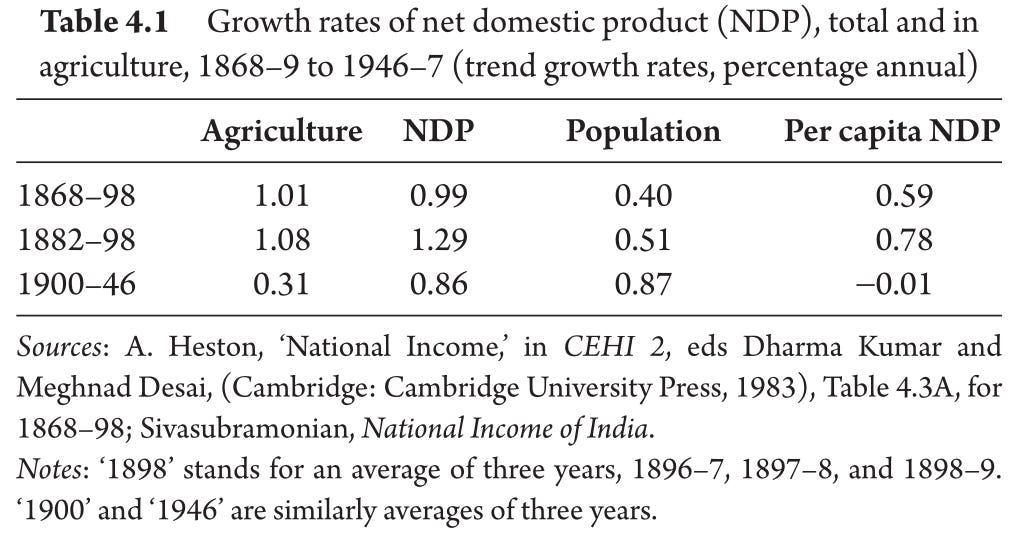
So what happened in the agricultural sector? Roy shows that, the net domestic product of agriculture grew at roughly 1% annually from 1868 to 1898, and then only grew 0.3% from 1900 to 1946.
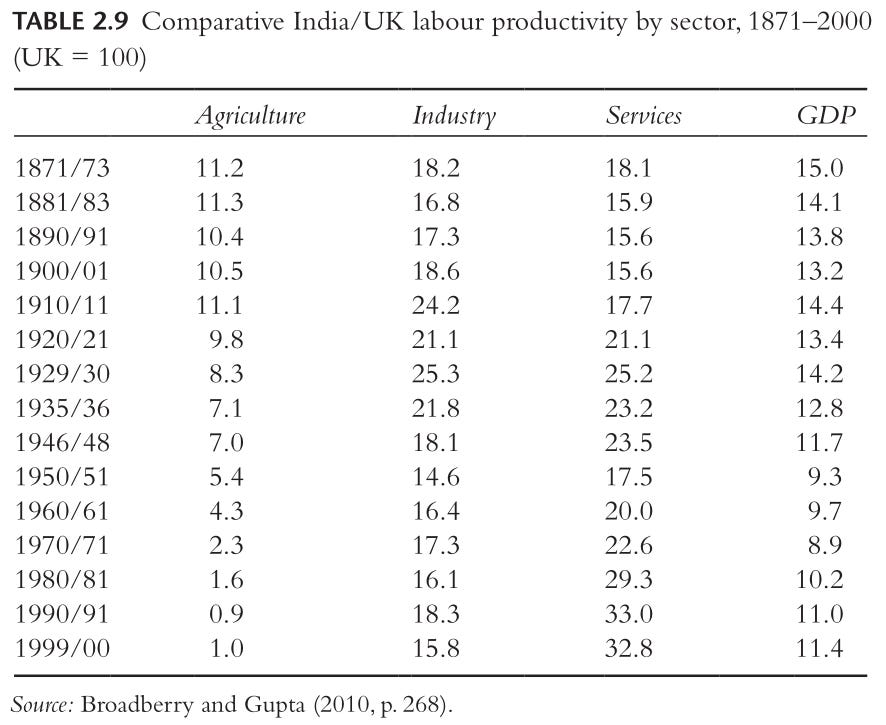
In addition to this pattern of overall growth in agriculture, Broadberry and Gupta’s reconstructed productivity measure shows that compared to the UK, agriculture productivity in India was very low but stable from 1871 to 1911, after which it began to drop precipitously. All this lines up with the overall trend of the economy growing gradually in the pre-war years and then stagnating in the post-war period.
So what were the underlying forces behind the initial growth of agriculture and its stable productivity relative to the UK? Roy argues that irrigation projects improving access to water and commercialisation partly driven by the construction of the railways, were the main forces. The British Raj built canals since much of the Indian sub-continent faced climatic risks that caused periodic famines. Agriculture depended on monsoon rains and then faced long dry periods that made consistent yields outside areas with perennial rivers, especially much of the Deccan Plateau, risky. Canals helped expand the cropped area and increased yields. This was particularly effective in Punjab where government canals increased the area irrigated by 95.5% from 1885 to 1938 (Roy, 104). In India overall, cultivated area increased from 31% of total area to 49% from 1870 to 1939. Roy does report though that a side effect of this growth in agriculture was that nomadic pastoralists declined as they lost access to common grazing lands and either settled as peasants or turned to wage labour.
Commercialisation involved, as Roy says, the integration of markets within India, raising the relative price of agriculture exports due to industrialisation of other goods, and trade reorganising the agriculture sector (Roy, 104-105). Commercialisation as a whole generally gave peasants greater access to markets, and led them to grow cash crops like cotton, wheat, and rice, but it did not raise real wages for agricultural labourers (Roy, 129).
As the productivity data shows, the effect of irrigation and commercialisation began to wear off as the expansion of cultivated area slowed; the First World War disrupted global markets and worldwide agriculture prices began to decline from the 1925 onwards. This was all followed up by the Great Depression in 1929 (Roy, 75, 105) which increased rents and the debt on rural Indians. Other changes like land reform and underinvestment in agriculture due to small land holdings also contributed to productivity stagnating and getting worse relative to other countries.
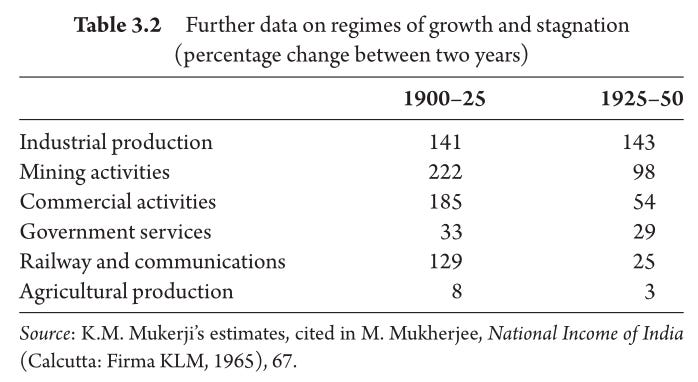
The rest of the economy did not follow the same pattern as agriculture. As we saw earlier, industry grew its share of national income steadily after 1900. This is also borne out on production data as well.
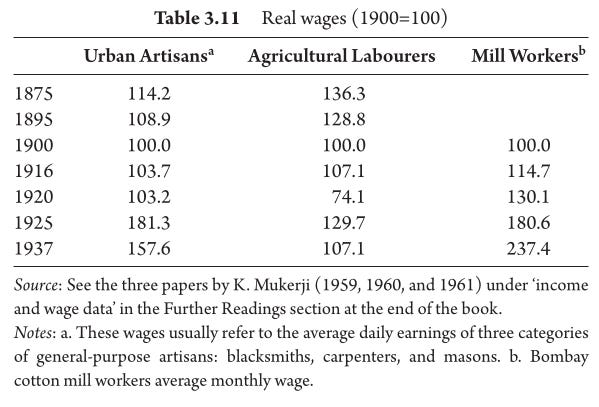
This growth also affected ordinary people with wages in mills and urban artisans growing faster than agriculture in the post-war period.
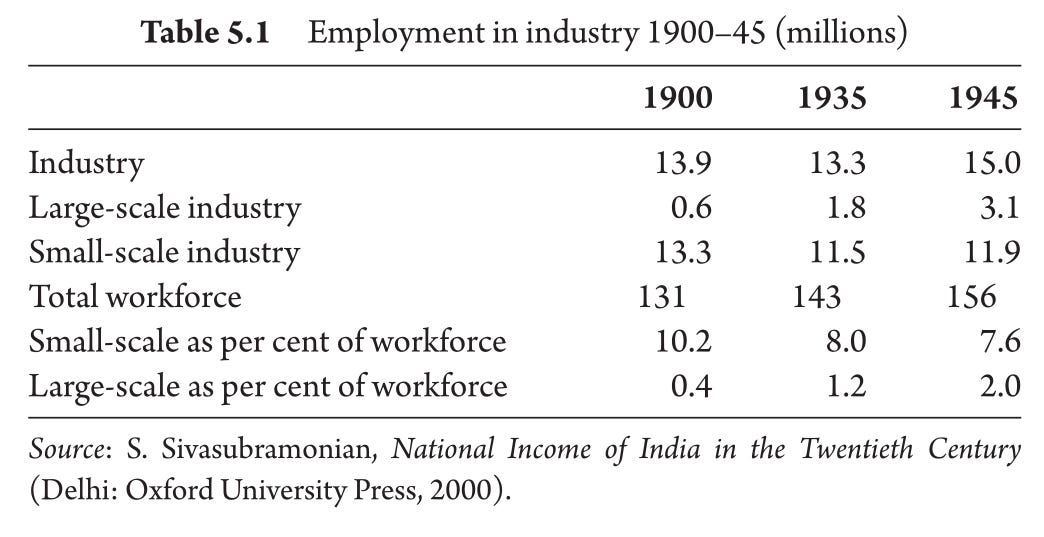
However, the industrial sector did not grow uniformly. Roy (140) distinguishes small-scale industry (eg. handloom weaving, leather making, pottery, tile and brick making, metal working) which is largely defined by the small-scale of production in households and small factories, from large-scale industry (eg. textiles, agriculture commodities, metals, machines and chemicals) which had produced goods in large quantities in large factories or with machines.
The data from 1900 to 1945, essentially the second half of the colonial period shows that the proportion of employment in small-scale industry declined slightly. Over the same time period large-scale industry grew rapidly albeit from a very small base (Roy, 141). In 1900, small-scale industry employed 20 more times the workers in large-scale industry, by 1945 it was only 4 times.
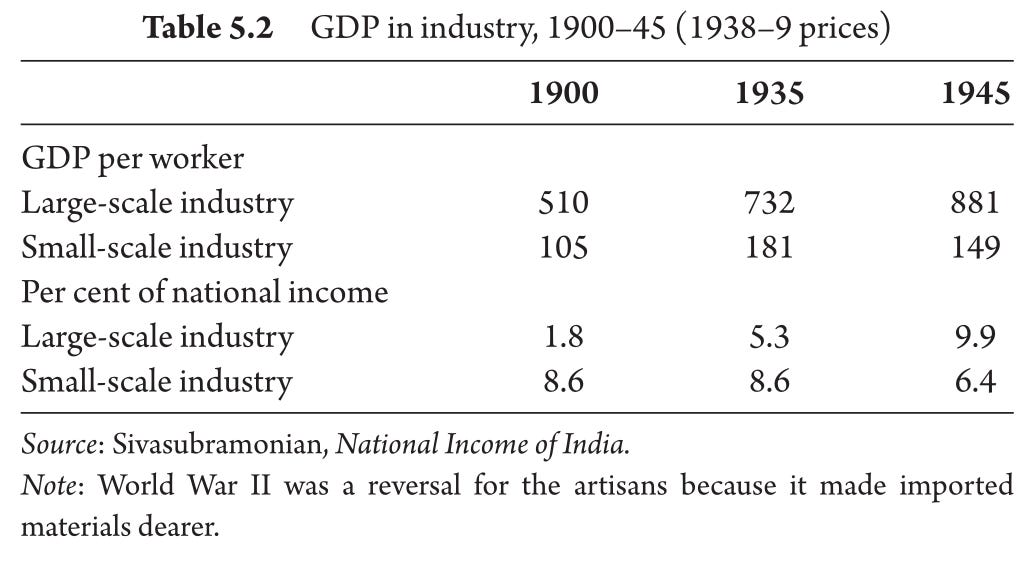
Over the same time period productivity increased in both small-scale industry and large-scale industry, but far more rapidly in the latter (Roy, 145). However, small-scale industry’s share of national income stagnated and slowly declined lower than large-scale industry’s by 1945.
So what explains this trend of declining small-scale industry and rising large-scale industry? Roy’s explanations are interesting in that they challenge the narrative, common in popular discourse, that India was deindustrialised. As Roy tells it, in the colonial period up to 1900, there were two major developments. The first is that industrialisation in Europe led to the decline of some small-scale industry like handloom cloth production, and iron smelting because the imported goods were much cheaper. Roy notes that this does not mean that small-scale industry was destroyed by the importing of industrially produced goods. Rather, those firms and workshops involved in making simple goods were affected badly, but those requiring high skill survived (Roy, 145-146).
Roy produces data which shows this pattern in the production of cloth, where the initial decline in production of handloom cloth is led by the importing of cloth in the late 19th century. But, as production of Indian mill cloth grew, so did the production of handloom cloth that had intricate designs or used delicate fibers like silk. To that end, there was no devastating deindustrialisation in India as the nationalist narrative is often told.
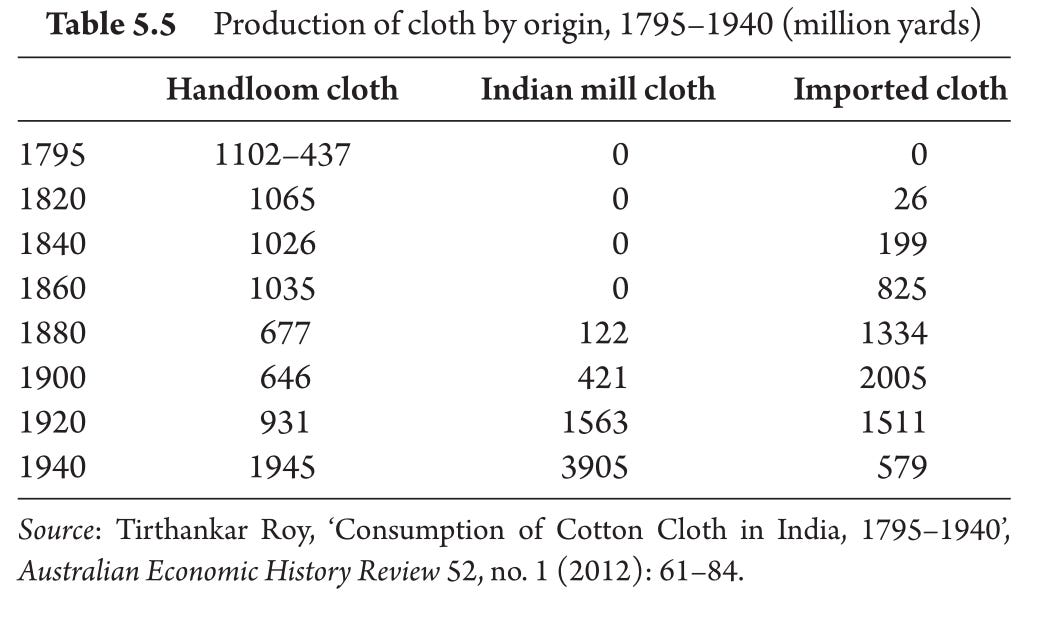
The second major development in the colonial period was that World War I changed the colonial government’s attitude to industrial policy. Before World War I, the colonial government did not have any industrialisation policy aside from keeping markets free and trade open. Therefore, Indian industries had to start off by competing with foreign imports (Roy, 164). In addition capital raising was difficult as interest rates in India were high at the time. Bankers preferred not to lend for long-term investment, and there was little capital available through public savings. All this along with the scarcity of skilled technical labour and managers, meant that industry was slow to develop. However, the experience of shortages during the First World War, led the colonial government to protect select industries through import tariffs, and steer government procurement towards Indian sources (Roy, 165).6 Again, this does not suggest a colonial government that was dedicated to the deindustrialisation of India.
Despite the change in government policy, by 1925, world prices of “steel, paper, sugar, and cement” hurt Indian industry, and the Great Depression starting in 1929 severely affected export industries like jute (Roy, 167). By the end of the colonial period, the India economy had industrialised in a peculiar way. Its industries were largely capital intensive. It employed lots of labour and consumed lots of resources to mainly produce textiles materials and process agricultural commodities (Roy, 162). As such, it remained low productivity compared to other developing economies.
Another part of the unequal growth story is plantations, mining, and banking, as they are the main sectors for the 15% of the workforce working outside manufacturing and agriculture. Roy’s discussion on these sectors is interesting, although it is lighter in its use of economic data and statistics than the sections on agriculture and industry. The most interesting part was the discussion of plantations. Roy (189) reports that by 1921, of the 821,000 workers in the plantations, 91% worked in tea, while 7% worked in coffee and rubber. Roy’s description of the development of tea plantations, first in Assam, and then in southern India in the Nilgiri Hills, is fascinating for the discussion of working conditions and the migration of labourers. So too is the discussion of the development of coffee in Mysore, Coorg, Travancore, and Wynaad, from the 1870s, which unlike tea had a more even share of Indian and European owners (Roy, 195). Overall, Roy (196) reports that despite their bad image of indentured labour poor conditions, “plantation labour paid better wages and more regular year-round wages; labourers received food security and medical care more than in agricultural villages.”
In mining, Roy concentrates largely on coal as it was the main mineral produced. The data shows that coal production grew from 2.3m in 1891, 18.4 in 1921 to 28.3m in 1938-19, and about 30m in 1947.
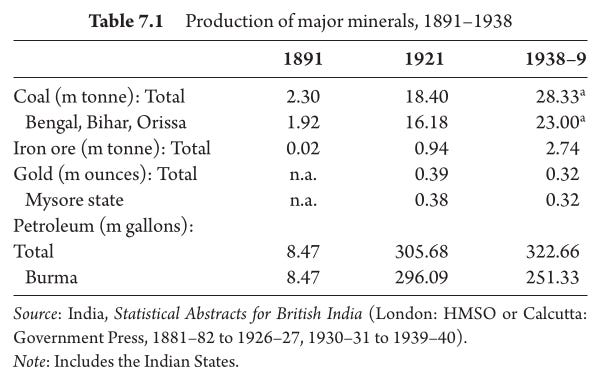
What explains this outsized growth in coal mining? Roy (197) argues it was mainly the expansion of the railways in the late 19th century that became both a consumer of coal, and also transporters of coal from mines to industries. Overall, Europeans firms were the major players in coal, although smaller firms tended to be Indian owned and run. However, Roy (200) reports that the productivity was low. It was about half of a British miner, and ¼ of an Australian miner. This was because firms became used to the low wages and high turnover of labour hire practices and did not want to improve productivity and pay more. To be sure, the pay was low but it was higher than agriculture.
The most interesting aspect of Roy’s discussion of the banking sector is the rise of Indian banks and how they eventually drew more deposits than the government’s Imperial Bank, and the Exchange Banks dealing in foreign exchange.
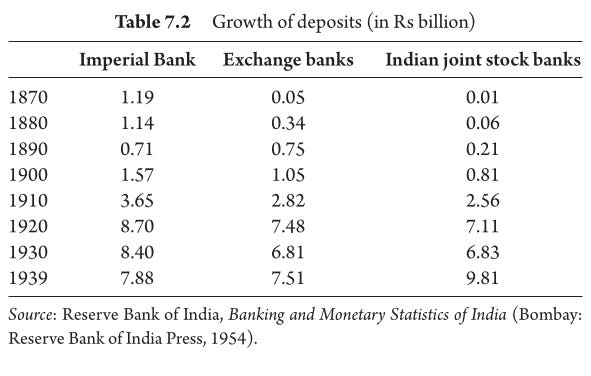
As Roy (204) explains it, the Imperial Bank serviced “businesses connected with European enterprise and that small segment of Indian enterprise that the Europeans understood”. The Indian banks serviced the small to medium sized indian business. Overall, despite these limitations, banking developed in Indian society. As Roy (209) says, “Bank deposits as a proportion of GDP increased from less than 1 per cent in 1870 to 12 per cent in 1935”. Roy (209) also reports that there was some declining trend in real interest rates through the colonial period. However, there was little evidence that the cost of long-term capital fell much.
Roy’s discussions of different sectors of the Indian economy are some of the best parts of the book. They offer an evidence based picture of the mix of forces that affected the Indian economy through the colonial period up until Independence. The emphasis on climatic conditions in a largely agrarian economy was especially eye-opening and showed how the colonial government was trying, although not really succeeding, at raising living standards for the most Indians through irrigation and opening access to world markets. On the other hand, access to global markets and a colonial policy of trade protection helped industries, plantations, mining, and the financial sector to grow, albeit from a small base, and raised living standards for those employed in them. Almost more interesting is that the decline of the overall economy as agriculture declined after 1920 with a fall in global prices and then the Great Depression, puts into perspective the economic discontent that fueled the nationalist movement. I think this perfect coincidence of economic conditions is underappreciated as a factor that made Indian independence possible.
For Roy, the inequality in growth between agriculture and the rest of the industries that he lays out in the book, invites his second question: why did people not move out of agriculture and to places with higher paying jobs? Roy’s answer to this is the least clear of all his explanations and is scattered in various sections of the book. In Chapter 6, Roy (172) says that migration to work in the industries in the cities was not a way to escape agriculture, rather it was a supplement to increase incomes when agricultural work died down. This kept people connected to agriculture. In Chapters 6 and 10, Roy (172, 259) also says that men mostly migrated because the social practice of early marriages meant that women in their prime working age were already married and looking after children. This left little capacity for work or education for most women. Finally in Chapter 14, Roy professes uncertainty about the causes, saying:
We cannot be sure where the limits came from: caste as a barrier to occupational choices, poor state efforts on education, limited access to training, low female age at marriage that ruled out shifts of occupation for most rural women, or technological change in the growing activities.
All of these sound plausible, but the lack of any data that measures their effects leaves the reader somewhat unsatisfied.
Infrastructure and the State in the Colonial Period
Of course the history of an economy is not complete without touching on the development of infrastructure and the role of the state. After all, these contribute a great deal to how an economy grows. According to Roy, the story of infrastructure in the colonial period is one of unequal development across British India; this is largely because the state did not have a concerted developmental policy. Nevertheless, for Roy (213), the nineteenth century saw the state focus on “irrigation, railways, roads, and the telegraph”.
As I mentioned earlier the colonial government saw that in order to raise agricultural productivity and avoid periodic famines, irrigation was required. Roy (215-216) catalogues the astonishing number of projects on this front. However, he also notes that irrigation projects did not immediately vanquish famines, because their capacity was shaped by the natural supply of rainfall. While they definitely transformed the previous wastelands of the Sind and Punjab, raised agricultural productivity, and reduced famines in certain places they did have certain environmental effects like water logging and saline deposits.
Railways on the other hand, as we shall, played a more important role in eradicating famines in areas of poor water access. The development of the railways during the colonial period was an astonishing industrial and infrastructure outcome. As the data shows, the railways grew in almost every way between 1860 to 1940. As Roy (222) says, “The railways had revolutionized the mobility of people and goods in India.”
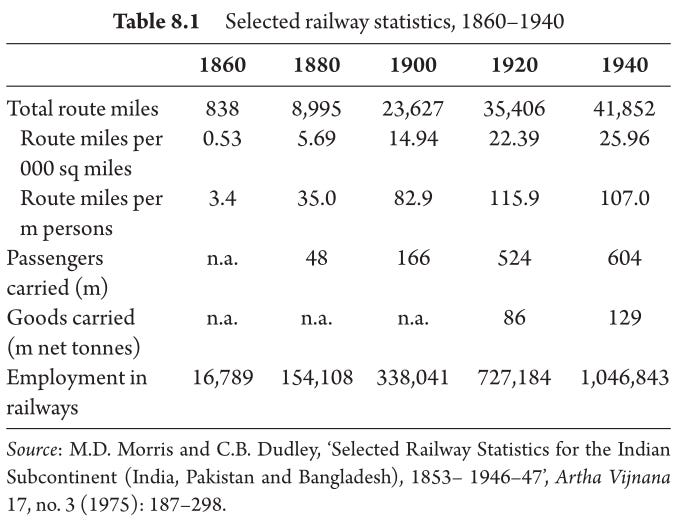
So what explains this rapid growth? As Roy (220) tells it, railway development in the colonial period went through four phases. The first phase between 1849-1869, was through private enterprise. The second phase between 1870-1880 saw a shift to state owned enterprise. The third phase between 1881 and 1924 saw a shift to private enterprise management with state ownership. Finally the fourth phase from 1924 onwards was under a full state ownership regime. A key element in the early phases was a condition that the government would have the option to buy the railway lines after 25 years, and that the government would guarantee 5% return on capital if the companies failed to earn the 5% return by themselves. For Roy this provided a strong incentive for private players to build railways without a fiscal cost for the government. However, as the guarantees became burdensome themselves, the government invested directly in the railways.
Roy’s discussion of the economic effects of the railways is measured and balanced, and illuminating. He notes that although their construction provided some general economic stimulus and allowed new economic activities, this effect was quite weak until the first world war (223). This was because most of the materials came from Britain, with increased demand on coal mining the only significant economic benefit. After the first world war, the demand for construction materials and labour within India increased. This had a side effect on the forests, as deforestation increased with the demand for timber sleepers by the railways.
The second economic effect Roy (223) highlights is more interesting though; the railways significantly reduced transportation costs and as a result integrated markets across the sub-continent. This helped reduce the regional variability of grain prices.
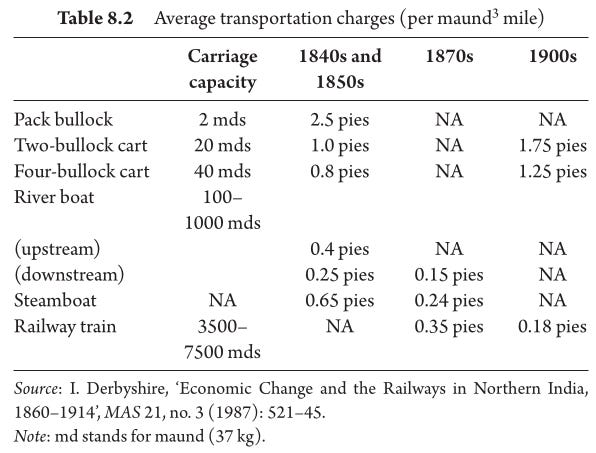
Despite these benefits, Roy (223) claims that “the Indian nationalists relentlessly criticized the railways”. The nationalists argued that the railway guarantee contributed to a drain of resources away from India, and the railways as a whole increased the risk of famines by allowing easier exports and only helped British capital returns. However, Roy (225-226) argues that research done first in the 1970s and 1980s, and recently in 2010 and 2016 using new statistical data, shows that the railways had a net benefit to the Indian economy by playing a significant role in preventing famines, and lowering the cost of trade.
If the railways were an astonishing feat with significant benefits, the same cannot be said of the rest of the transportation infrastructure. As Roy (227) says, “In 1931, the length of metalled roads as a ratio of the population (1000 persons) was as low as 0.4 miles. For comparison, the ratio was above one in much of contemporary developing Asia (1.5 in Ceylon and 2.2 in Malaya)”. Roy explains this underinvestment was due to, the high costs of road construction, the inability of the government to reap a return, and the lobbying of British industrial interests for railway construction. This is undoubtedly a significant failure of the colonial government.
Aside from the railways, the other notable achievement in infrastructure that Roy documents is the postal and telegraph network constructed by the government. The data Roy (230) provides shows a significant increase in the use of the postal and the telegraph network from the start of the colonial period to 1921, and then a stagnation after that until 1938-39.
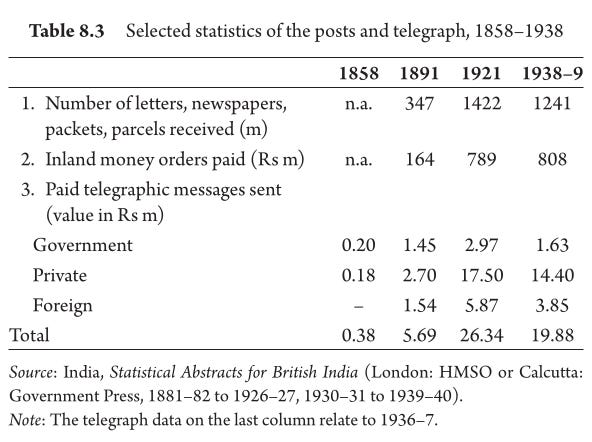
Roy’s main explanation for the growth of the postal system was that its services, particularly postal money orders, were a “lifeline” for poor migrants travelling for work. The motivation for the telegraph network was less commercial. Roy’s explanation is that it was largely constructed for military reasons by the state. Roy doesn’t offer any explanation of why the use of the postal and telegraph networks stagnated after 1921. One likely explanation is the overall stagnation in the economy as a result of the global economic Depression in the 1930s. The accounts of the postal system and the telegraph network, show that they are underappreciated in how economically transformative they would have been since nothing like either of these pieces of infrastructure existed before the colonial period.
If there is an example which most clearly shows the inequality in infrastructure development it is education and healthcare. Roy (61-62) claims that the reports by the Company during the pre-colonial period in Bengal and Bihar shows the Indian schooling system at the time was largely privately maintained small one class or one teacher schools, where enrolment was largely confined to upper castes and boys. These factors contributed to a very low literacy rate. Parimala Rao’s recent book Beyond Macaulay: Education in India, 1780–1860 challenges some of Roy’s accounts.7 Rao (16-19, 23) brings together a fresh analysis of bureaucratic minutes and archival sources, to show that there was an indigenous schooling system in which boys of different castes were enrolled. Nevertheless, the enrolment numbers Rao provides suggest the schooling system was not of adequate supply for the number of children at the time. Overall, Roy claims the main shift during the pre-colonial period was that education changed from a “private or community good” to an “open-access public good”. This involved the incorporation of the existing vernacular schools into the state infrastructure, and opening Arabic and Sanskrit schools, and English schools after 1852.
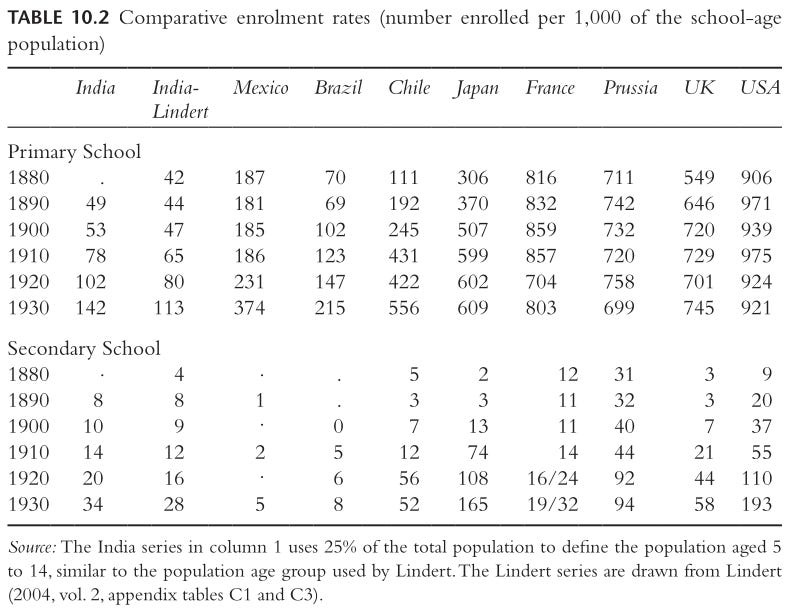
Despite the opening up of education during the pre-colonial period, the general trend of low enrolment continued during the colonial period. Students enrolled as a proportion of population went from 1.3% in 1891 to 3.7% in 1931 (Roy, 233). However, the children of schooling age as a proportion of the population was around 40% across those years. This abysmal record is confirmed by Latika Chaudhary’s chapter on schooling in A New Economic History of India which shows that the enrolment rates for primary and secondary schooling were low by international standards.8 The secondary schooling rates were comparable to France, but well below Japan, Prussia, the UK and the USA. The primary school enrolments were even more dismal at a rate far below the other countries.
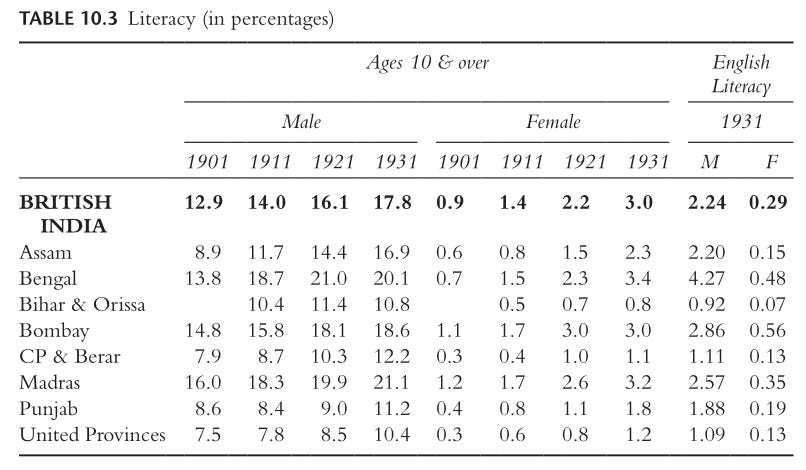
The increasing enrolment rates over the colonial period, did not have much of an effect on literacy rates. Male literacy increased from 12.9% in 1901 to 17.8% in 1931, with female literacy increasing from 0.9% to 3%. This is dismal to say the least.
So why did education infrastructure remain so poor during the colonial period? Roy’s first reason is striking: the state was too poor. As Roy (234) tells it, “The government did not have the money to build a mass education system that could accommodate 100 million children in 1931.” Moreover, with primary education left to local governments, the regional variability in taxation led to inequalities of education throughout the provinces. In addition, Roy also puts long-standing caste prejudices as an impediment as the state simply did not want to fight social battles that might cause unrest. The state-sponsored system was also concentrated in the towns and cities and so favoured the castes that already had high literacy rates as they were the first to urbanise. This is certainly a different picture to the common view that English education was imposed by the colonial government.
Roy (234) also takes aim at private investment in education. Here the first problem was again the caste system. Certain castes had more of a history in demanding education than others; this led some castes and classes to underutilise the schooling available as they did not yet see its usefulness. Also where schooling was managed locally, access was also prejudiced against lower castes and classes. Both factors contributed to a situation where castes and classes had high literacy rates and a high likelihood of going onto secondary and college education.
According to Roy, the caste and class inequality in education ultimately meant high enrolment in secondary and college education and low enrolment in primary education. Even though the university system grew quickly in the colonial period, Roy notes that the system imported the British model and so had a bias towards literary education which did not lend itself to development of scientific research.
To get a sense of the healthcare infrastructure though the colonial period Roy (262) cites the overall mortality rate which was quite high during the colonial period by modern standards (consider the crude death rate of the OECD since 1960 has been below 10 per 1000 people).9 From 1881-91 to 1911-21, the crude death rate was steady at around 40 deaths per 1000 people. This dropped steadily after 1921.
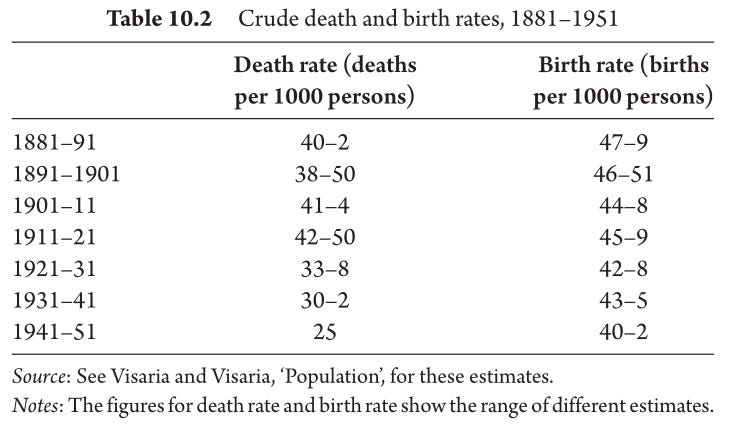
Roy (238) attributes three government programs that contributed to this: “sanitation, medical care, and famine prevention”. In terms of medical care, Roy reports that efforts had begun in the pre-colonial period with the India Medical Service which was set up to look after the Company’s soldiers. However its remit widened and the government began to expand it during the colonial period. Roy notes that these hospitals were mainly used by Anglo-Indians at first as the hospitals were concentrated in cities, and upper caste Indians saw them as impure places. However, these attitudes changed as people began to see the success of surgery in government hospitals. In sanitation, reforms were made early in the colonial period to ensure clean water supplies and proper sewage. However, Roy argues that the sanitation and medical care, while important for individuals, did not have much of an effect on the health of the population as a whole since they were limited to urban areas. This is what explains the high death rate up until 1920.
For Roy (270), the decline in mortality after 1920 is better explained by the famine prevention measures taken by the government. Roy points out that when it comes to hard data, there are no good sources before 1800 on the frequency or severity of famines. However, after that period the sources are much better as Roy (271) lists 11 famines and concludes that, “Practically every known famine in nineteenth-century India started because of failure of the monsoon rains, usually successive failure of rains”. The succession of famines in the 19th century led to a series of commissions that studied famines and overturned the widespread belief at the time that famines were natural disasters in the face of overpopulation. Rather, the commissions concluded that famines were caused by a “risky agrarian environment” (Roy, 272). As a result, after 1880, the government implemented a policy to relieve the effect of famines by opening relief labour camps where individuals could sign up to work on the railways and irrigation projects in exchange for food. This would reduce the effect of famines, but also construct railways to ensure grain could be transported more easily and help irrigate areas to prevent famines from occurring.
Overall, increased irrigation led to higher yields, and the railways, enabling a more efficient distribution of grain, reduced the occurrence and impact of famines. So much so that famines disappeared from 1900, save for the Bengal famine of 1943 (272). So why did the Bengal famine of 1943 occur? Roy points out that it was unique in that it was not caused by a failure of the monsoon. Unfortunately, in the book, Roy (274) does not commit to an explanation, pointing to disagreement among historians, some scholars claiming there was in fact a harvest failure, and that rivalries within the Bengal legislature led an ineffective response. However, Roy is more definite in an edited volume chapter with Latika Chaudhary, Bishnupriya Gupta, and Anand V. Swamy.10 There, contrary to Amartya Sen’s explanation that it was caused by a combination of price inflation due to government war spending, speculation and hoarding, administrative chaos, export controls between regions, and an inequality in purchasing power between labourers and those in the war effort, the authors argue that re-examinations of the data have shown there was a lack of supply, and even evidence a fungal disease severely affected yields in 1941 and 1942 (Chaudhary et al, 112).11 They also point out that one in five of those affected by the famine were cultivators, which is consistent with a supply shock and not merely prices bid up by higher demand.
Roy’s data and explanation of the famine prevention measure is compelling. It shows that the prevalence of climatically caused famines in India before and during the colonial period is an underappreciated fact. It also shows the colonial government did care about learning why famines occurred and tried to prevent them. It also explains the surge in population after the 1920s. As the mortality rate went down, the earlier cultural practices of a high birth rate did not adjust.
Explaining the State
A significant portion of Roy’s explanation of the unequal development of infrastructure, involves the colonial government not having a developmental policy. As Roy (242) says, “Its main concern was to keep trade and factor markets open”. This can largely be seen by comparing the composition of the state’s expenditures from the beginning of the twentieth century to the eve of independence from in the Cambridge Economic History of India which Roy uses as a source.12 Spending on education and health as a percentage of total public expenditure barely crossed 5% for education and 3% for health from 1900-1 to 1946-7, whereas spending on defence was consistently around 25-30%.
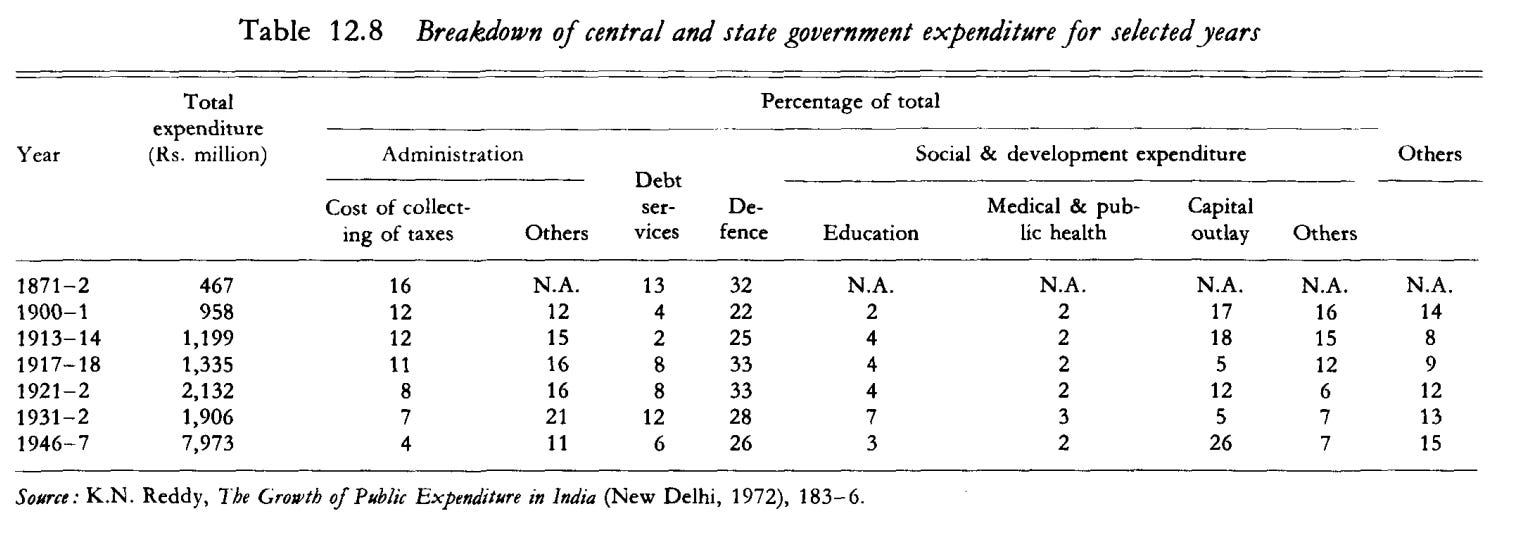
The reason it distributed spending this way was because revenues were also low. As Roy (243) puts it, “The British Empire in India was a poor state. Tax per head in British India was among the smallest not only in the world but also within the imperial domain. The state earned too little money because it relied on the land tax and land yielded little”. Roy justifies this on the basis of figures calculated by Ewout Frankema in ‘Raising Revenue in the British Empire, 1870–1940: How Extractive were Colonial Taxes?”13 which show that Gross Public Revenue per capita in India went from 0.27 pounds per capita in 1871 to 0.42 pounds per capita in 1937, compared to the UK where it went from 4.82 pounds to 35.99 over the time period. Indian revenue by head of population was low compared to the dominions, British Africa, and the colonies in the Caribbean.
All in all, the government in the colonial period had little state capacity to develop India. It raised little revenue (between 8-12% of national income) and also spent little (between 8-16% of national income) by today’s standards. For instance, consider that in 2024 the average tax to GDP ratio in the OECD was 34.1%.14
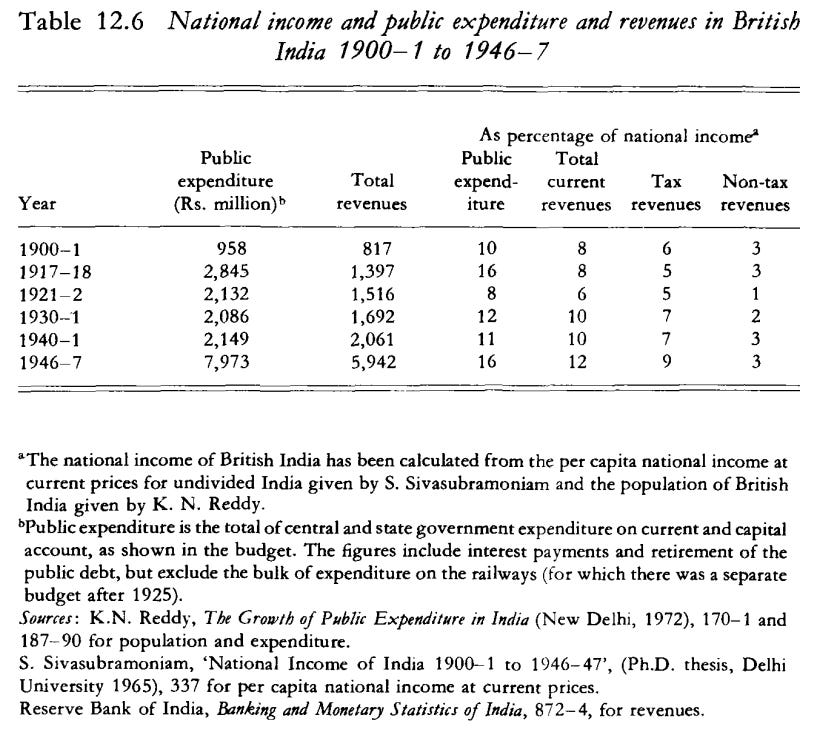
Why then was the government run like this? Roy’s striking answer is that rather than any malicious intent, the structure of colonial governance was responsible. According to Roy (241-242), what made the colonial government colonial was that it had several decision making centres that did not work together. The India Office in London issued currency and raised loans, and was concerned largely with defence and keeping trade open. The Government of India collected customs taxes, salt tax, opium tax, and borrowed money, and spent it largely on public works, the army, and legal infrastructure. Finally the provincial local governments raised land taxes, which was divided with the central government, and spent its share on roads, education and healthcare. The provinces faced a problem because there was a large inequality in how much land tax they collected. This meant some provinces raised little revenue and spent little as well. As Roy tells it, even after this system of divided revenues was ended in 1919, with the Government of India taking the income tax, and the provinces receiving the land tax revenues, the inequality remained.
For Roy, these three levels of governance not working together meant that public policy was slow to innovate new taxes aside from the land tax. As Roy (244) shows, at the start of the colonial period, the land tax and the tax on opium exports and sales of salt accounted for the significant majority of revenues. The application of the other taxes was limited until after the First World War when customs taxes and income tax began to grow as a share of revenue.
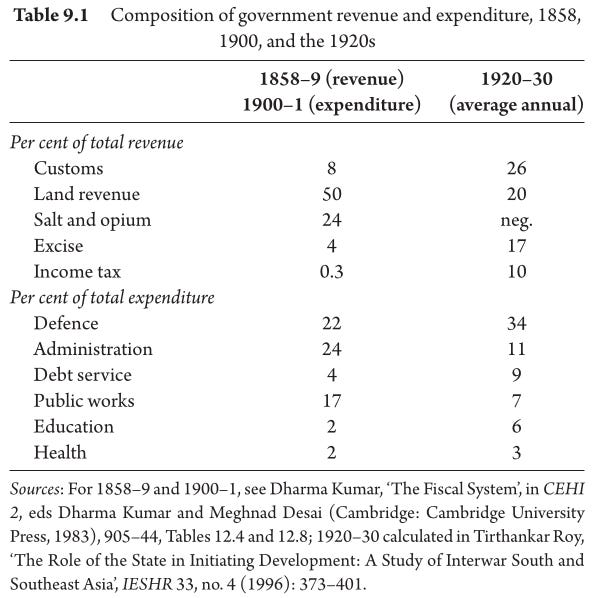
All this led to a poor state, which caused the government to rely on debt. But, even here despite having access to the cheapest debt markets, the government was reluctant. For Roy (247), the data is inconclusive on why the government was reluctant, but suggests that they feared the growing nationalist movement which attacked interest payments on public debt as a drain of wealth from India.
While Roy’s explanation is interesting, one problem with it is that even modern states, which no one would call colonial, have several decision making centres. Many states have exactly three with federal, state or provincial, and local government, each with its own legally assigned powers for raising revenue and spending. Does that make them colonial? Moreover these states are able to raise more revenue and deploy them for developmental goals. Another problem in the explanation is that it is not clear how “divided heads of government” makes for slow innovation. It seems equally likely that it could have the opposite effect with separate decision making centres developing policy on their own without the constraints of having to work with the other levels of government.
A more plausible explanation might be that the Government of India was run as a small state during the colonial period because that was the prevailing view of how states should be run in the British Empire. Income taxes did not rise to modern levels in the UK until the First World War, the UK’s government debt to GDP ratio steadily declined in the colonial period until the First World War15, and the modern welfare state was not established until after the Second World War. In simple terms, the Indian state was run how the British thought states in general should be run in the colonial period - with minimal taxes and debt.
These explanations of the small size of the government during the colonial period stand in somewhat contrast to the Indian nationalist movement’s complaints that the colonial government oversaw a drain of wealth from India to the UK. Was this justified? It certainly gets a lot of attention in popular discourse. Most recently, Nievas and Piketty used it in a recent working paper as an example of one of the forms of wealth transfer that allowed the UK to accumulate foreign assets with a deficit in goods trade.16 Roy (93-94) shows that from 1921 to 1939, private payments flowing out of India were about 2.9 to 2.7 % of national income, while the same government payments were about 1 to 1.2%.
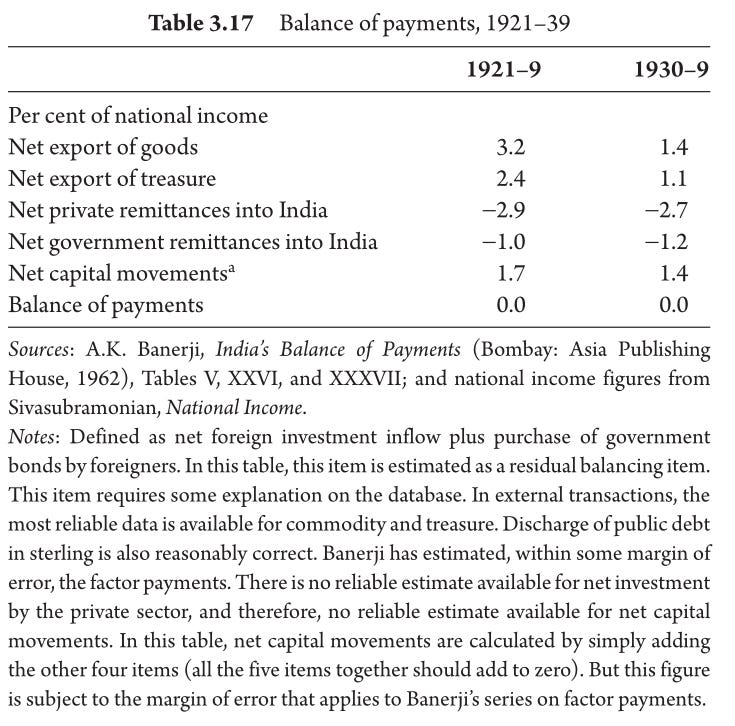
As Roy explains, the allegation of a wealth drain by the nationalist movement during the colonial period focused on the government remittances (ie. the “home charges”), and the net railway dividend which guaranteed profits for railway companies. The home charges made up 43% of the factor payments at the beginning of the colonial period and then declined to 28% by 1938-9. It was composed of debt servicing payment for the military, and for pension payments for those who had worked in India but retired in the UK.
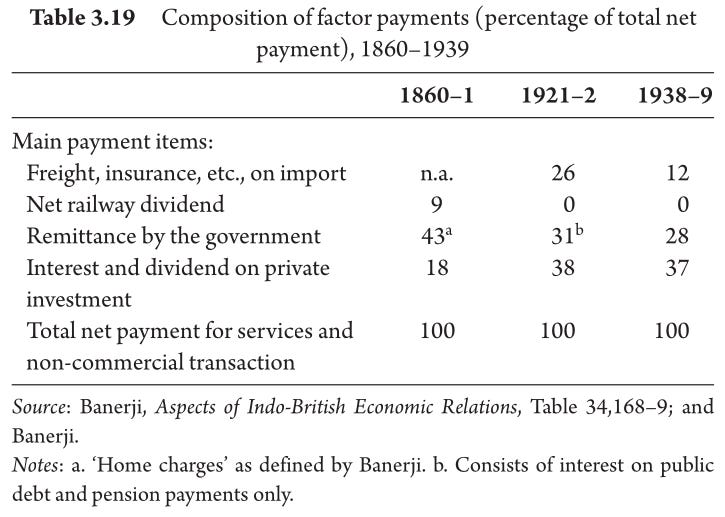
The question in light of the data is: were the ‘home charges’ a wealth drain? Roy persuasively argues that it is difficult to see how they were. Firstly, the home charges made up roughly 1% of national income. This is hardly the sort of drain of resources that can systematically underdevelop or impoverish a country as large as India.17 The second point is that it is hard to describe the home charges as a drain at all. A drain implies payment for goods and services not rendered or lower value than the payment. But, as Roy (94-96) explains, the home charges involved payment for services that the Indian government could not provide itself. It serviced debt the government used for infrastructure, paid for the maintenance of the army (while the British government paid for the navy), and paid the pensions of officials and govt employees who had retired back in the UK. It guaranteed a rate of return for railway companies which would have been unlikely to build the railways without the guarantee.
I realise it is tempting to see Roy’s explanations of the state as offering an easy excuse for its poor developmental record. It couldn’t develop social goods because it was poor, and it was poor because it did not tax enough, and it didn’t do that because of the structure of colonial governance (although I have my misgivings about this last explanation).
But, sitting as we do so far in time from the period, I think we can be more judicious. We can take the long view of history and judge the colonial government as a government. We can question, on the one hand, the outsized spending of the colonial government on defence as opposed to health and education (particularly primary education), while also understanding the economic, structural, and ideological constraints it faced. We need not fall into the dogmatic, and comforting, camps of denouncing the colonial government as intentionally malicious or celebrating it for bringing civilization to India or the only protection from outside threats.
If we attempt this more judicious view of the British Indian state, it raises a reasonable question about the other type of government that existed at the time: what about the princely states? These states - about 40-45% of undivided India - while accepting the suzerainty of the British crown, maintained their internal autonomy. They were a collection of 560 states, diverse in their size and the way they were ruled. Roy notes that the data from princely states is worse than British India so it is hard to completely see how they developed.
Nevertheless, from the data Roy (304) provides, by 1905 the princely states were similar in their revenue raising capacity (raising similar amounts per square mile in total and land revenue), the extent of railways they built, their urbanisation, and their literacy rates. They were different in that the princely states tended to have lower population density, lower cultured area, lower rainfall, a greater reliance on non-agricultural industries and the revenue from them, and a worse road network.
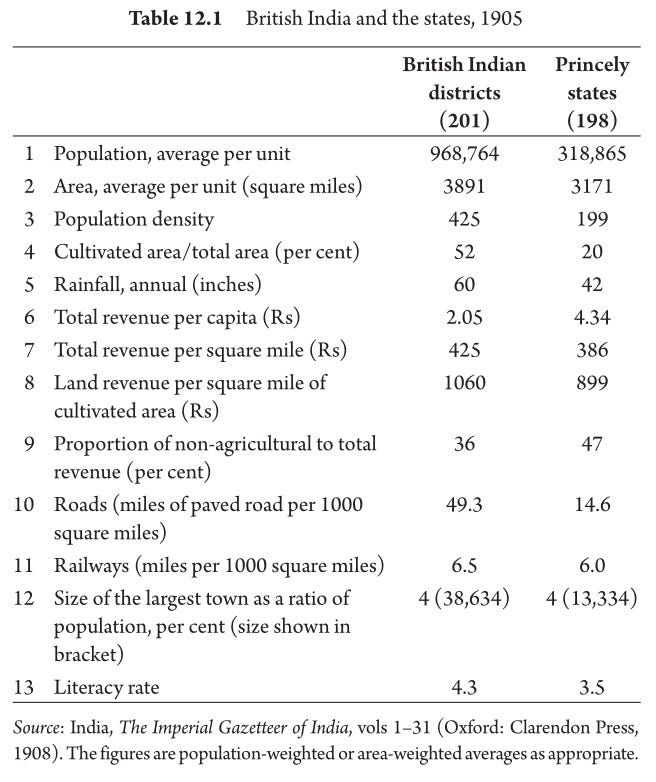
For Roy (303), the similarities are largely explained by the rulers of princely states seeing prosperity the same way the British did, by the commercialisation of agriculture and building railways to trade. As a result the rate at which land tax was raised was similar and they built railways at roughly the same rate. State spending on social goods like education was also equally poor.
However, commercialisation and trade were more difficult for the princely states as they had less agricultural land, and most states were inland in hilly regions (Roy, 305). British India was different because the Gangentic plains were abundant in agricultural land, and its prosperous districts were on the coast with access to maritime trade routes. This meant that the princely states relied more on non-land taxes and were on average poorer than British Indian provinces (Roy, 306). This led to lower investment in infrastructure, with poorer road networks and limited urbanisation. Another factor that explains the differences is that whether through a lack of encouragement by the British government, or a lack of knowledge of how to access credit markets, very few princely states raised foreign debt.
Roy points out there were four exceptions to this general pattern in the princely states. These were Travancore, Baroda, Mysore and Hyderabad. These states were big enough to raise enough revenue for development projects on their own (Roy, 310). These projects were a mix of social and economic projects. As Roy puts it, Travancore focused on education, Mysore focused on state sponsored industrial projects and electricity, and Hyderabad relied on its landowners and traders to spur industrialisation with the help of the state. Baroda on the other hand set up banks giving it shares in the broader textile industrialisation as it was connected by railways to Bombay and Ahmedabad.
Overall, Roy’s account shows that the princely states were a mix. Those with enough tax capacity could afford development, those that couldn’t were as poor or poorer than comparable British Indian provinces. However, the reader is left with a sense that there could be more to discuss given how much of the Indian subcontinent was ruled by the princely states. It is unfortunate that the data is sparse especially on the four princely states Roy marks out for special consideration.
From the Colonial Period to Independence
On the precipice of independence in 1947, the growth in the non-agriculture sectors and the stagnation in the agriculture sector culminated in 60% of national income being earned in the former and 40% in the later. This was a change from 49% and 51% respectively in 1900 (Roy, 9). While this drove economic growth, it was severely unequal. Most of the country remained poor because 75% of the workforce still worked in the agricultural sector, just as it had done in 1900 and 1875. The average annual real wage in agriculture in 1946 was Rs 31; this is roughly what it was from 1857 to 1900 (Roy, 129).
These economic facts on their own would seem to condemn the colonial period as a failure. And, while I will leave Roy’s account of independent India’s economy for another post, the significant growth in the economy after independence would seem to justify that condemnation. But, as Roy’s book shows in rich detail and with great acuity, efforts were made to raise living standards, boost productivity, and deliver some social goods during the colonial period. Claims of malicious intent by the colonial government to keep India poor, to drain it of its wealth, or deliberately ignore famines, do not hold up. To be sure the colonial state’s record as a developmental state or even in the provision of health and education was a major failing. However, the effect of historically contingent pressures like the First and Second World War and the Great Depression are underappreciated in how they constrained the state and the economy, and likely caused the material discontent that made the nationalist movement and Independence possible.
-
Tirthanker Roy, The Economic History of India: 1857-2010, Oxford University Press, 2023. ↩
-
See Angus Maddison, Contours of the World Economy, 1–2030AD: Essays in Macro-Economic History 2007, Table A.6, p. 381. ↩
-
See https://medium.com/lessons-from-history/the-british-empire-made-india-poor-1032aa29a591 for one example, but a google search will show many more on other websites and on social media. For example, https://infogram.com/share-of-world-gdp-throughout-history-1gjk92e6yjwqm16. This post on substacks links to more examples, https://substack.com/home/post/p-158682586. ↩
-
Shashi Tharoor, “Saying Sorry To India: Reparations Or Atonement?” in Harvard International Law Journal, 2018, https://journals.law.harvard.edu/ilj/2018/07/discussion-do-colonists-owe-their-former-colonies-reparations/ ↩
-
Stephen Broadberry and Bishnupriya Gupta, “Indian Economic Performance And Living Standards 1600–2000” in A New Economic History of India, 2016. ↩
-
Bishnupriya Gupta’s “The Rise Of Modern Industry In Colonial India”, in A New Economic History of India, provides more details on how industry protection developed and the challenges to industrialisation in colonial India. ↩
-
Parimala Rao, Beyond Macaulay: Education in India, 1780–1860, Routledge, 2020 ↩
-
Latika Chaudhary, “Caste, colonialism and schooling: education in British India” in A New Economic History of India. ↩
-
https://data.worldbank.org/indicator/SP.DYN.CDRT.IN?locations=OE ↩
-
Latika Chaudhary, Bishnupriya Gupta, Tirthankar Roy, and Anand V. Swamy, “Agriculture in India”, in A New Economic History of India. ↩
-
Amaryta Sen, Poverty and Famines: An Essay on Entitlement and Deprivation, Oxford University Press, 1983, p. 75-78 ↩
-
Dharma Kumar, “The Fiscal System” in the Cambridge Economic History of India, 2008 ↩
-
Ewout Frankema, ‘Raising Revenue in the British Empire, 1870–1940: How Extractive were Colonial Taxes?’, Journal of Global History 5, no. 3 (2010): 447–77. ↩
-
https://www.oecd.org/en/publications/2025/12/revenue-statistics-2025_07ca0a8e.html ↩
-
https://ourworldindata.org/grapher/uk-government-debt-as-a-percentage-of-gdp-17272016 ↩
-
Nievas, G., Piketty, T., Unequal Exchange and North-South Relations: Evidence from Global Trade Flows and the World Balance of Payments 1800-2025, World Inequality Lab Working Paper 2025/11 ↩
-
Tirthanker Roy, “Economic History and Modern India: Redefining the Link”, Journal of Economic Perspectives, Vol 16, No 3, Summer 2002, p.121 ↩