From Independence Onwards
Part Two of a Review of Tirthanker Roy’s The Economic History of India, 1857-2010
Subscribe on Substack, via RSS/Atom, or follow me on Twitter for updates
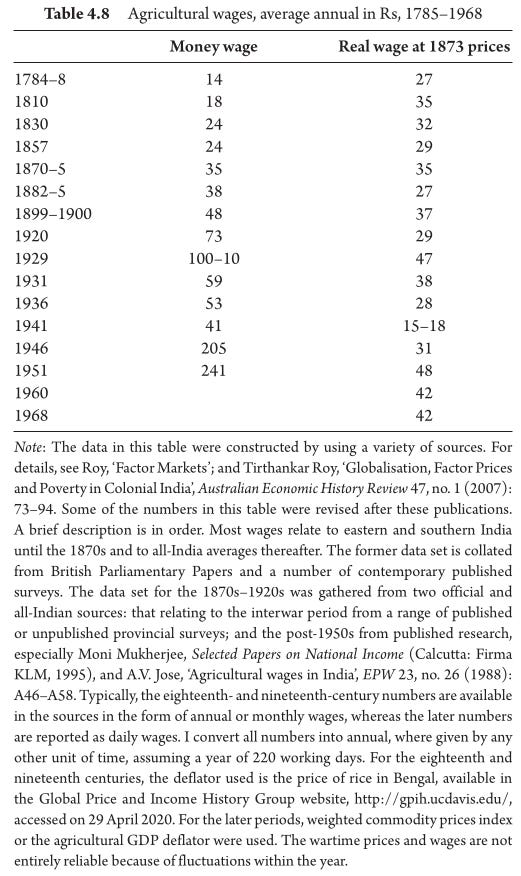
In part one, I went through Roy’s The Economic History of India, 1857-2010, from the pre-colonial period until the end of the colonial period in 1947. Here I take up the story from the start of the post-independence period when both the governance and economic trajectory of India changed. Roy notes that at independence in 1947, India was a mix of cities, some of which were the most industrialised in Asia, and villages where most of the population lived working in agriculture. For all the economic growth that took place during the colonial period, most of it left most of the Indian population untouched. As I mentioned in my previous post, this stagnation can be seen in the data on real agricultural wages that Roy produces which show wages in 1946 were at the same level they were from 1857 to 1900.
For Roy (319-320), the period immediately after independence involved three developments. The first was the settling of huge migrations that took place with the partition of British India into Pakistan and India. This involved people moving east and west, and some leaving behind all their lands and assets. This was a largely unplanned process. The second development was the incorporation of the princely states into the new country. This was more planned than partition.
The third development was the drafting of a new economic policy. This policy was motivated by a nationalist narrative that blamed colonialism and globalisation for the poverty and inequality in the country. It was also preceded by The Bombay Plan of 1944, devised by a group of India’s leading industrialists, which called for rapid industrialisation relying heavily on public investment and protective tariffs to substitute imported manufactured goods with domestic production. One part of this policy, which Roy (320-321) calls “protectionist industrialisation” was drafted into policy in the years leading up to 1950.
Roy (320-321) notes two interesting aspects of the new economic policy. One is that unlike developing economies at the time who adopted a similar policy, India eschewed its traditional long standing industries in favour of capital intensive industries where there was no extant expertise. This meant the state had a much larger role in investment that it otherwise would have. Another part of the new economic policy, which Roy reports was always in tension with the part that saw industrialisation as the means to development, was the idea of rural development and self-sufficiency inspired by Gandhi. This policy was focused on alleviating poverty in India’s villages.
The First 15 years after 1950
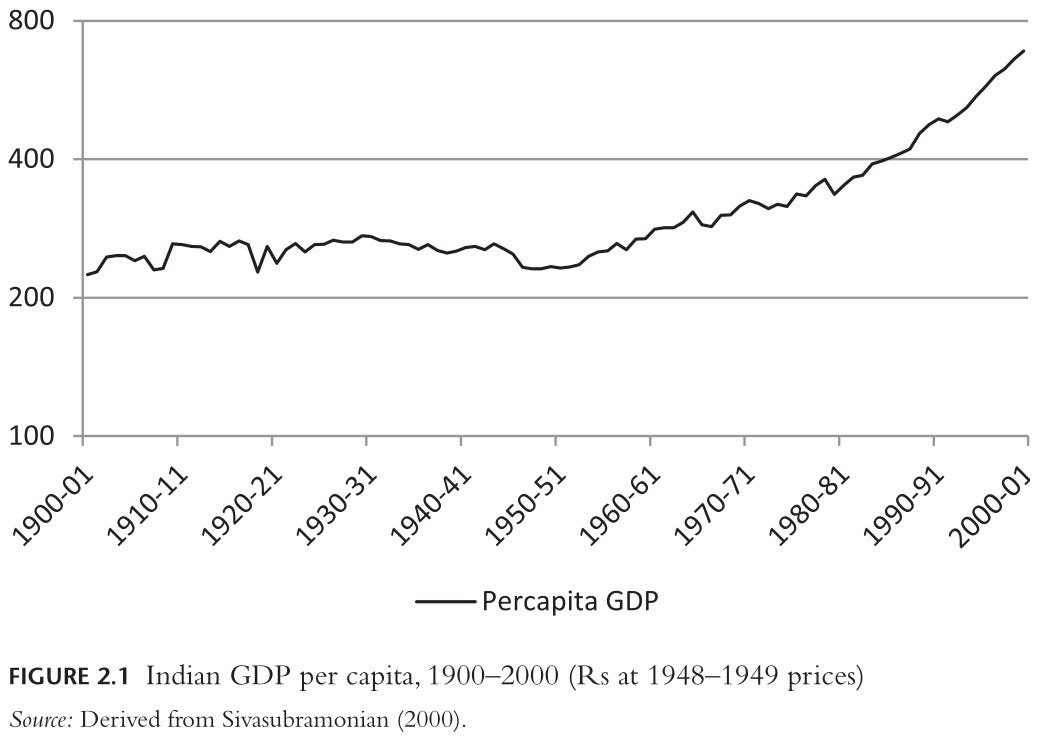
The First Five-Year Plan in 1950 solidified the new economic policy and the following five years saw more institutions develop to implement it. The difference in the first 15 years after 1950 to the pre-independence colonial period is stark. As Broadberry and Gupta show GDP per capita grew significantly, clearly putting to shame the lack of development in the colonial period.1
The main source of economic growth, as Roy (323) shows, was in the manufacturing industries where GDP grew at 6.8% annually between 1950-1964 compared to 2.3% from 1910-1940.
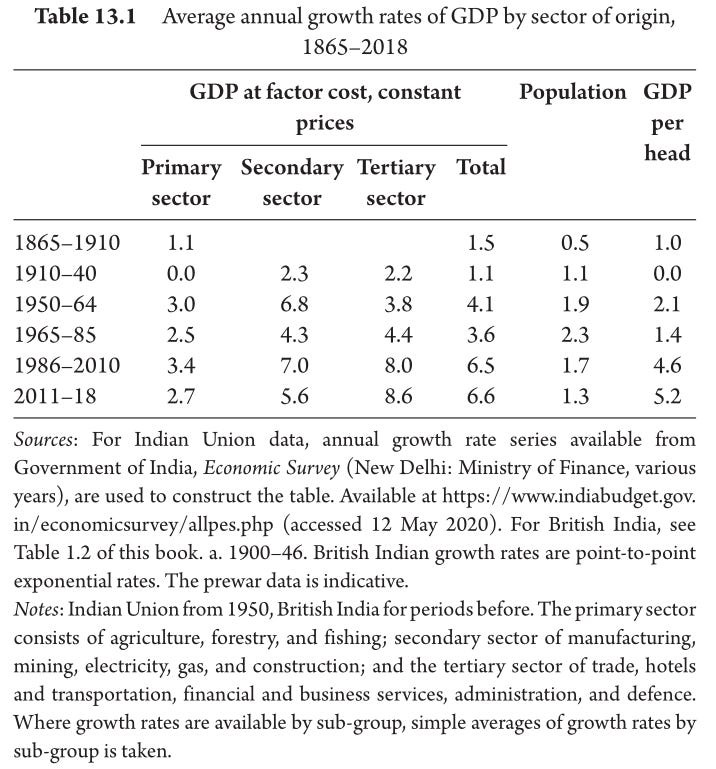
But this is not to say agriculture didn’t grow - recall that is where most Indians still worked. As Roy (335) shows in the sectoral data, the primary sector grew at 3% per annum from 1950 to 1964 compared to no growth between 1910 and 1940. Growth in agriculture can also be seen in the wage data that Roy (129) shows, where the average real agricultural wage in 1951, 1960, and 1968 returned to levels they were on the eve of the Great Depression and early 1930s.
For Roy, the economic growth in the first 15 years after independence was largely the result of the new economic policy, with its focus on industrialisation, and a rural development policy. With industrialisation, Roy (322) explains much of the growth was due to public investment by the state in “oil, gas, steel, heavy machinery, railways, and power”. Surprisingly, Roy notes, the private sector’s traditional export oriented industries did not immediately plummet. Rather, investment fell with some industries turning towards domestic production.
In rural areas, one part of the policy involved irrigation projects, namely building dams and canals. Roy notes however this was largely focused in the North. It is unfortunate that Roy does not provide much detail on dam construction during this period. Having said that, it appears quite hard to find recent official statistics on dam construction and completion during those 15 years. Nevertheless, according to the National Register of Large Dams in 2015 there were 67 dams over 10m in height constructed before 1900, 305 between 1901 and 1950, 234 between 1951 and 1960, and 499 between 1961 and 1970.2 This is an extraordinary increase over the colonial period and shows the extent to which the new economic policy helped growth in the agricultural sector.
As Roy (323) reports, in the rest of the country the rural development policy involved “land reform and collective use of resources via cooperatives and community development”. Roy explains that the aim of land reform was to redistribute land from landlords to peasants to remove landlords as an interest between peasants and the state. The idea was that peasants that owned their own land would work it harder and so raise productivity. Roy notes that this only worked well in a few states, and so we are left to conclude that it had little impact on agricultural growth. Since Roy does not offer any more evidence for this explanation, it is hard to assess how plausible it is. Fortunately, modelling by Besley and Burgess (2000) of the effects of land reforms in India’s sixteen largest states between 1958 to 1992 appears to justify Roy’s explanation to some extent.3 They show that there is little evidence that the reforms had any effect on state wise agricultural income per capita and yields, indicating the reforms had little effect on raising agricultural growth. However, their modelling does show that the land reforms, particularly the removal of the intermediaries and revising of tenancy terms, did significantly reduce rural poverty and increase real agricultural wages (406-407, 417). To that end, the land reforms can be said to have had some positive effect on social development.
The Next 20 Years 1965-1985 The end of the first fifteen years is crucial in Roy’s view of what comes after. Roy reports that the mid-1960s saw two developments. A change of government following the death of Jawaharlal Nehru, and a harvest failure and famine which severely affected rural living standards.4 The first brought Indira Gandhi to power, and the second played a large role in motivating the rural developmental policy over the next twenty years.
Overall living standards continued to grow in the 1965-1985 period, but at a slower pace than the previous fifteen years. Compared to the previous fifteen years, GDP per capita grew slower at an average of 1.4% per annum, with the tertiary sector growing faster at 4.4%, but with the secondary and primary sectors growing more slowly at 4.3% and 2.5% respectively.
So what explains this slowing pace of growth in the 1965-1985 period? For Roy, there were three crucial changes in government policy. The first is that in response to the harvest failure and famine in the mid-1960s, agricultural development shifted to what is termed the Green Revolution and a campaign to eradicate poverty in India’s villages. The Green Revolution was a policy that aimed to increase the productivity of agriculture by the use of new high-yield crop varieties from America, and the use of new chemical fertilisers (Roy, 324). However, Roy argues the Green Revolution only boosted production in areas where irrigation was viable, and so did not change rural poverty much on the whole. In the 1970s, to alleviate this poverty the government began construction of infrastructure in villages and distributing food to poor consumers at subsidised prices along with subsidising producers when supply was abundant to keep prices afloat. This anti-poverty campaign led to a large outlay from the government’s budget.
The second change in government policy was a general tightening over private capital. The major plank of this according to Roy (325) was the Monopolies and Restrictive Trade Practices Commission which, starting in 1970, controlled the expansion and diversification of businesses with assets above a certain threshold. Along with this, the state’s share of investment was increased further with the nationalisation of banks, and insurance companies. New banks were also set up to lend particularly to industry. This overall tightening over domestic private investment sources and business activity through government licences was probably the apotheosis of what has been termed derogatively as the “Licence Raj”.
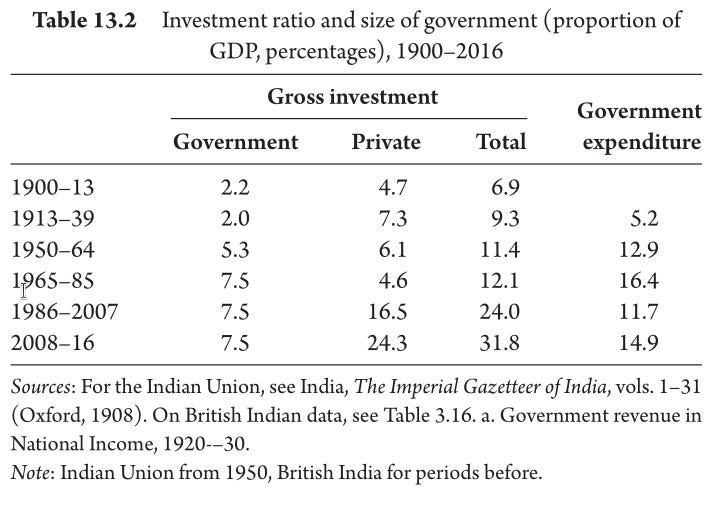
Both the expansion of the state’s expenditure and the increase in the government’s share of investment can be seen in the data (Roy, 336). Government investment while holding steady at 7.5% of GDP, private investment fell from 6.1% of GDP to 4.6%. Government expenditure rose from 12.9% of GDP to 16.4% of GDP between 1965 and 1985.
The third change in policy that explains the decline in growth rates was an increased hostility towards foreign investment in the private sector. As Roy (325-326) tells it, by the mid-1960s, three quarters of the developmental loans from the USSR were going to the public sector, and three quarters of the loans from the USA were going into the private sector. Soviet aid had by then flowed into state owned oil refinery projects, and with India restricting the expansion of private refineries, its relationships with western first and governments like USA in the oil and steel industries began to wane. In addition India had become dependent on Soviet oil for its industry. All this meant that with the Indian state as the primary investor in the economy the USSR became a vital ally for pursuing its policy of protectionist industrialisation. This tie with the USSR only became closer in the second half of the 1960s and the 1970s as India and Pakistan fought wars in which the USSR supplied India, and the US and China supplied Pakistan. Roy (327) reports that by the end of the 1960s, “India’s trade regime was nearly collapsing in these years. The balance of payments was forever under pressure”. However India was able to continue importing oil from the USSR because of a trade agreement that allowed India to pay for imports with Indian goods rather than its foreign currency reserves. Despite this by the end of the 1960s, Roy (327) reports that, “a quarter of India’s exports went into servicing debts to the USSR”. This closeness with the USSR and its consequent anti-Americanism, ultimately led, according to Roy (328) to the Foreign Exchange Regulation Act in 1973 which restricted business from sending private income overseas, international businesses from holding majority shares in Indian businesses, and the free use of foreign exchange by private business. The result of this for Roy (329) was a significant decline in investment as international firms left India, or stopped investing. The regulations also caused a decline in investment by domestic firms as they found it difficult to import new technology. This hurt exports as Indian firms became increasingly uncompetitive on the world market.
Taken together the three changes in policy are supposed to explain the slowing growth in the economy and resultant living standards between 1965 and 1985. The shift in agriculture and rural policy weighed down the budget; tightening controls over capital led to slowing business activity and domestic investment; and finally, the worsening of India’s trade balance and the tightening control over foreign investment led to lower investment.
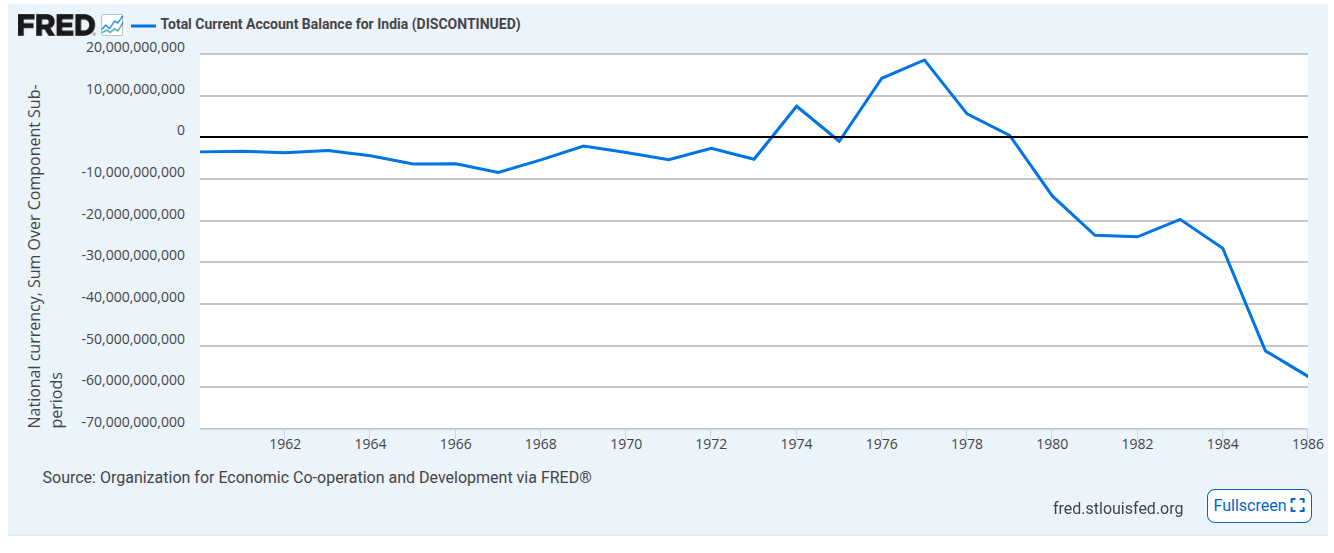
As for evidence to justify Roy’s claims about India’s restricted trading regime, the historical data on India’s Current Account Balance5 does appear to show that India ran a trade deficit from at least 1960 to the mid-1970s and then ran a sharper deficit after that.6 This does show that the value of Indian imports exceeded the value of her exports, and perhaps shows that tariffs were making those imports expensive.
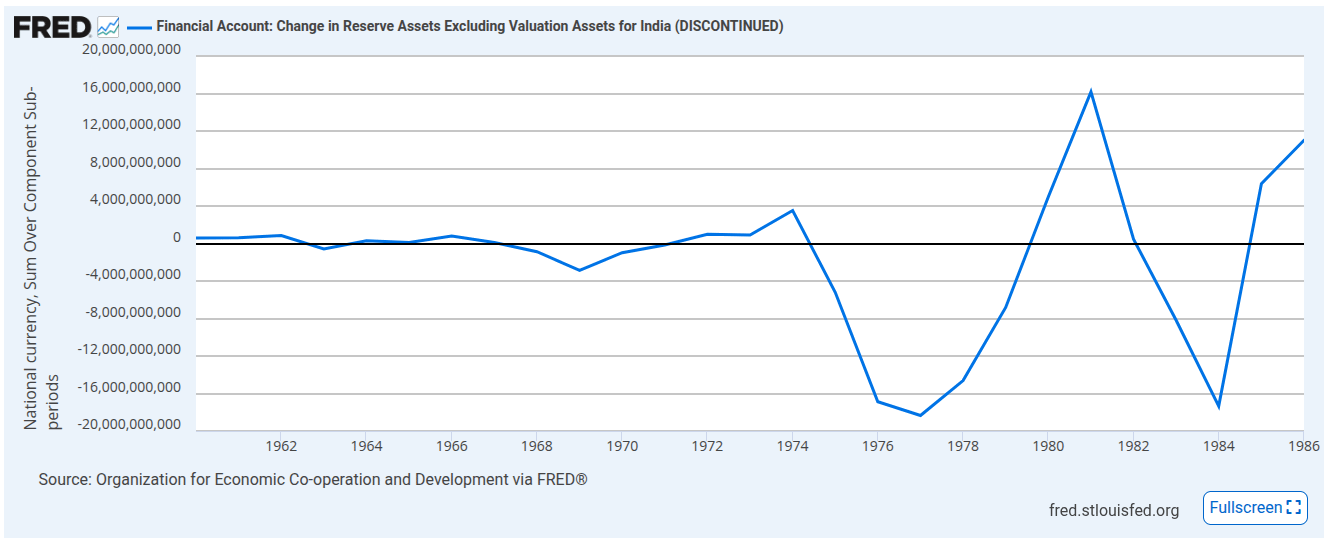
The data from the Financial Account might also provide evidence for Roy’s claim of the decline in foreign investment.7 After 1974, there was a dramatic decline in credits, some of which would likely have been foreign investments in other circumstances.
The Transition to an Open Economy From 1986 onwards, the Indian economy began a transition to a more open economy. From Roy’s data, between 1986 and 2010, the primary sector grew by 3.4% per year, the secondary sector grew 7%, and the tertiary sector grew by 8%, all much higher than between 1965 and 1985 (Roy, 335). These growth rates combined with slower population growth greatly increased GDP per capita, which grew by 4.6% which was far and away better than the 1.4% of annual growth between 1965 and 1985. In addition, between 1986 and 2007, private investment grew to 16.5% of GDP compared to 4.6% between 1965 to 1985. What becomes clear from this data is that the growth of the Indian economy did not all start in the early 1990s as is often supposed in the public discourse. Rather an initial phase began earlier. So what explains this increase in economic growth rates and increased openness?
As Roy (330) tells it, in the first half of the 1980s the government began to open the economy slightly with more business friendly policies, less hostility towards foreign investment and allowing the exchange rate to return to the market rate. With the emergence of Rajiv Gandhi as prime minister in the mid 1980s, Roy argues there were three main developments for the economy. The first development was the flow of private remittances from Indian labourers in the Persian Gulf in the mid-1970s (Roy, 331). This considerably improved India’s balance of payments, as Roy claims, “The millions of Indian labourers who went to the Persian Gulf to work in the wake of the successive oil price hikes made the balance of payments solvent again. The reduced risks imparted stability to the economy and permitted the government to relax its trade and exchange policy”. Unfortunately Roy does not offer any data on this in his book. However looking at the data on total transfers in the current account balance, there is certainly a jump and then a continued increase around the mid 1970s in the transfers.8
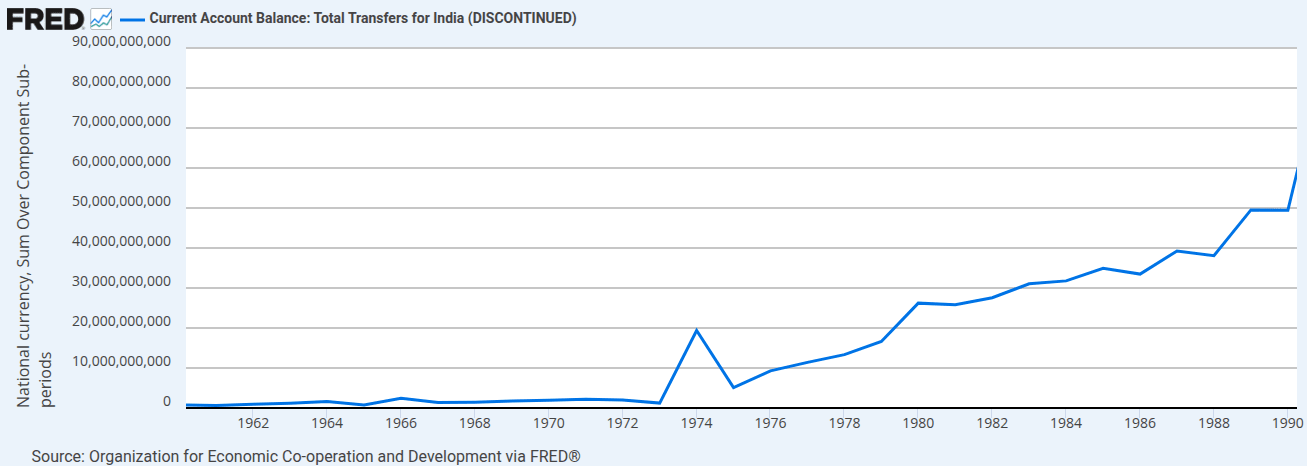
For Roy (331), the remittances stabilised the economy and allowed the government to relax its trade and foreign exchange policies. This led to the second development, which was a liberalisation of trade policy to encourage the importing of technology in the private sector particularly in computers and electronics from the mid-1980s. The remittances allowed for this as they provided the necessary foreign currency for the private sector to import technology. This was much needed according to Roy (331), as by the mid-1980s the USSR’s economy and its rupee trading arrangement, which in previous decades had benefited India, was collapsing. This meant that private sources like remittances were the only plausible way for India to pay for the imported technology.
The liberalising reforms were then expanded further in the 1990s with liberalisation of the exchange rate, a general roll back of state investment in the economy, and sharp reduction in import tariffs. All this was possible because of the pickup of private investment from the mid-1980s. The reforms continued in the second half of the 1990s with financial deregulation, privatisation of public enterprises and utilities, the removal of price controls and deregulation in industrial relations. According to Roy (334) all this had a strong impact on the “knowledge industry” part of the services sector and its exports. Roy cites the informational technology sector and the pharmaceuticals sector as particular beneficiaries of the new liberalisation of the domestic economy and the openness to trade. Interestingly, Roy notes that this growth in the information technology sector owed a lot to the emphasis on technical and high education during the early Nehru years and the opening up of the economy during the mid-1980s under Rajiv Gandhi.
Before moving on it is worth considering how plausible Roy’s explanation above is. Roy claims that by 1985 the USSR’s economy and the rupee trade with India was in collapse. Therefore, the remittances from Indians in the Persian Gulf were fortuitous because they came at a time when India needed foreign currency to import technology. The claims about the USSR’s economy and its bilateral trade with India are, I believe, overdrawn. Valdislav Zubok in Collapse: The Fall of the Soviet Union has persuasively argued that although the Soviet economy was not doing well by 1985 - Zubok describes Soviet revenues and finances as “precarious” - it was not collapsing.9 Its collapse was rather more due to the speed and scale of Gorbachev’s economic reforms in 1987 and later. India-Soviet trade was also not collapsing during the mid-1980s. Santosh Mehrotra in India and the Soviet Union: Trade and Technology Transfer shows that in 1985-1986 the USSR’s share of total Indian exports was 17.6% whilst it had varied between 9.9% and 21.3% since 1970.10 On the other side, the USSR’s share of total Indian imports was 8.5% whilst that had varied between 5.9% to 10.4% since the 1970s. Also, the absolute rupee value of the imports and exports were also not declining but were near their highest levels. This does not look like a collapsing trading relationship. The key factor I believe is that India’s trade with the USSR was done in rupees, meaning that whilst it was beneficial in not draining India’s foreign currency reserves, it also meant India did not earn convertible currencies from its trade. Given that, India had to finance its import of technology from the west from another source and the state of the USSR’s economy was tangential to that need.
Nevertheless, the most interesting point in Roy’s explanation is that it shows how exogenous the causes of the reforms were. The wave of liberalisation began because the government was a fortuitous benefactor of the economic circumstances. It is these circumstances that ultimately allowed for a liberalisation of the economy rather than any decisive ideological shift from socialism to capitalism.
Whilst all that was happening in the industries and services, a third crucial development occurred in the agricultural sector with a second Green Revolution that focused on the areas that did not have access to canals. It is worth pointing out that in 1987-1988, 65% of the Indian workforce still worked in the primary sector.11 As Roy tells it, this second Green Revolution was possible because of Indira Gandhi’s legacy of subsidising the spread of electricity into rural areas. As Roy (332) says, “Between 1970 and 1995, the percentage of villages receiving power increased from 34 to 90”. This enabled the use of electric pumps and wells to irrigate new areas from the 1980s onwards. For Roy (332), “The combined effect of the two waves of agricultural transformation was nothing less than revolutionary,” as it grew agricultural production incomes between 2% and 4% per year until the 1990s. This in turn ended the prospect of famines and India’s dependence on importing food. Roy’s explanation does seem to be justified as RBI data shows the production of foodgrains grew by 1.96% on average between 1985-86 and 2009-2010.12 In the same time period, production yield per hectare grew on average 1.98% per year.13
However, Roy points out that the story is not all rosy. In the mid-1990s the growth in agriculture slowed due falling water tables, unreliable electricity, and the overuse of chemical fertilisers. There is some evidence of this in the RBI’s production dataset which shows a decline in foodgrain production in 1995-1996 for the first time since 1986-87. This decline reappeared in 1997-1998, 2000-2001, 2002-2003, and 2004-2005. In addition, Roy (333) argues the restriction of exporting agricultural goods until 1995 also inhibited the effect of the second Green Revolution as it stopped farmers from making use of global market booms and so depressed private investment. After 1995 when the restrictions were lifted farmers began diversifying their crops into fruits and flowers.
Another area of economic trouble was manufacturing. Roy (333) reports that despite the liberalisation “manufacturing never regained momentum” and that in the 1990s “large-scale industry displayed a mix of bankruptcy and growth”. Unfortunately Roy does not offer any data to justify either of these claims and it is hard to find any official data on manufacturing to confirm it. However, if we take urbanisation as a proxy or labour market indicator for manufacturing, the data on that does show a lack of any acceleration in urbanisation after the liberalisation from 1980s and 90s.14 Rather, the percentage of the population living in urban areas has increased on trend from before liberalisation to 2010.
The final topic worth considering is the development in health and education in the Independence period. Unfortunately Roy does not devote much space to this point. The only description he offers is to say, in reference to Jean Drèze and Amartya Sen’s account in An Uncertain Glory, “Well into the 2000s, India stood badly on the benchmark called multidimensional development indicators relative to the poorer nations of the world, large emerging economies, and even South Asian neighbours like Bangladesh and Sri Lanka” (Roy (339). Roy does not offer any data to illustrate this description and moreover the description does not really tell us how health and education developed in the independence period.
Fortunately for us, publicly available data is more accessible for the Independence period than the colonial period. Following Roy’s use of the Crude death rate as a general measure of the health infrastructure in the colonial period, we can use world bank data to see the measure for India and its neighbours from about 1960.15 The data shows that India had a crude death rate of 19 per 1000 in 1960, which dropped to 11 in 1990 and 7 in 2010. This declining trend was in line with Pakistan, Nepal, and Bangladesh, which all made steady progress on improving the death rate, after which they all converged around the 1990s, and further converged with Sri Lanka around the mid 2000s.
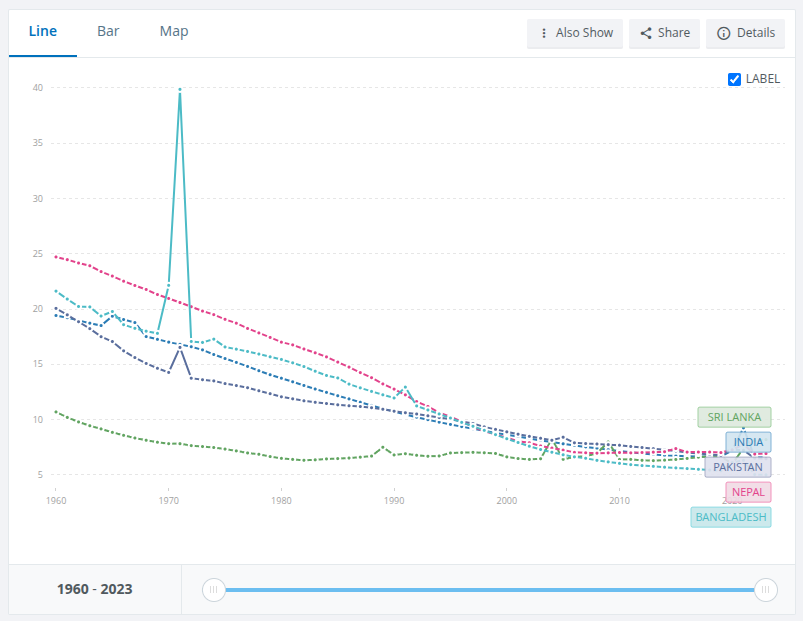
If health development is interpreted through the crude death rate, it is clear that progress was made between the start of the Independence period and mid 1980s and early 1990s when the liberalisation reforms took hold.
For education development, again following Roy’s use of the literacy rate in the colonial period, we can use the same measure reported in the census. Using a table compiled by Hanagodimath (2016) we can see that the overall literacy rate increased rapidly every decade from 16.67% in 1951 to 52.21% in 1991 and then to 74.04% in 2011. The female literacy rate also increased in the same way although lagging behind male literacy.
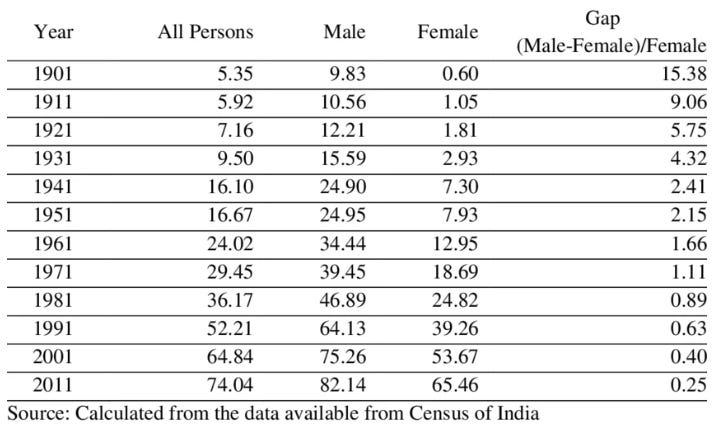
Again if literacy rates are taken as one measure of education development, it is clear again that considerable progress was made from the onset of Independence to the time of the liberalising reforms. To be sure, the increase from 1991 to 2011 is far more rapid than between 1951 and 1991.
Of course in absolute terms, health and education development did lag behind. For instance, Drèze and Sen in An Uncertain Glory show that in 2011 life expectancy in India was 65 compared to 73 in China, 74 in Thailand and 84 in South Korea; infant mortality was 47 per 1000 in India compared to 31 in China, 11 in Thailand, and 4 in South Korea.16 When it comes to education as we have seen above, literacy in India stood at 65% for women and 82% for men in 2011, whilst in China it was 91% and 97%, and 90 and 93% in Sri Lanka. The average years of schooling for those 25 years and older was 4.4 years in India compared to 7.5 in China, 11.6 in South Korea, and 6.6 in Thailand.
So, what explains this mixed and unequal development? Roy (339) motivates his account in contrast to Drèze and Sen’s explanation which he summarises as:
Privileged affluent consumers extracted more from the state, leaving little for the poor. The poor were deprived of access to the essential public services, and worryingly, the affluent classes shaped the public discourse on development. By saying this, Drèze and Sen criticized the economic liberal lobby that wanted more capitalism unrestrained by state regulation.
For Roy this explanation amounts to the idea that the Indian state was captured by the elite for their own betterment and when the state failed to deliver they embraced a liberalisation of the economy. Roy (340-341) argues this is a simplistic explanation because the state prioritised industrialisation, rural infrastructure and agricultural subsidies after independence given what the economy was like at the time. The fiscal burden of this focus naturally led to slower development in health and education, and also in other public infrastructure like transport, power, telecommunication services, and financial services. For instance, in education the emphasis on industrialisation meant the government focused on university and technical education to increase the number of engineers and professionals. However during this time, the private investment into education was sectarian and unequal for which the government cannot be blamed.
Roy acknowledges that none of this means there was no failure on the part of the government. However, he does not think this was a failure of ideology that led to the abandonment of socialism in favour of unrestrained capitalism. Rather, it was a combination of political will, unintended consequences and limited state capacity (Roy 340). He notes that a lot of the provision of public goods and services was down to the states rather than the central government and aside from some of the southern states many were indifferent about health and education development throughout the independence period. He also notes that through the years of the liberalisation reforms from the 1980s onwards, the states relied on sales taxes for their revenue. Some states lost this taxable income as economic activity moved from poorer states to the more industrialised ones, and even some of these industrialised states lost revenue because they waived sales taxes and fees to attract business and new investment. Adding to this the ability of the states to borrow was restricted by the central government. All this left the states with less state capacity for health and education development.
Roy’s explanation of the capacity of the states to develop health and education is hard to assess. It is difficult to find data on state wise revenues and taxes from the early 1990s to 2010 to see the changes in taxable income. Fortunately for us some research on this topic has been done. For instance, Montek Ahluwalia (2002) shows that until 1990-1991, many states had a positive balance in the current revenues which allowed them to spend on development.17 However, by 2002 these had all turned negative and with increasing fiscal deficits and lower expenditures In another study, Karnik and Rajus how that the own tax revenues of the states (ie. revenue they themselves raise) as a percentage of total tax revenues of India’s 17 largest states has decreased between the 2000-2005 period to the 2005-2011 period.18 When looking at tax effort (which is a measure of how much tax is raised as a ratio of how tax is available to be raised), they show that 13 of the 17 were raising less tax than they could in the 2005-2011 period than they were in the 2000-2005 period. All this provides some evidence for Roy’s explanation of the states losing taxable income in the post-reform period and having less to spend on health and education development.
Overall, the idea that springs to mind from Roy’s explanations of the Independence period is ‘path dependency’. By this I mean that a choice at one time depends on the order of the choices made at earlier times. The circumstances that the Nehru government found itself in after independence was a stark one. Seeing the world as it stood then, with so much of the world industrialised and so much of it already industrialised, what choice but rapid industrialisation did they have? With this came the inevitable trade-offs; there were less resources to focus on primary education, health and other public infrastructure. The earlier choice of implementing protectionist industrialisation created the circumstances where further industrialisation required trade liberalisation so new technology could be imported. Another example might be the Green Revolutions, which in their successes likely slowed urbanisation. This also meant later governments had to keep subsidies going into agricultural and rural areas. In all this, it is hard to apportion blame too harshly when the scope of one’s choices are foreclosed by earlier choices and their consequences.
As a whole Roy’s book is an astounding work. It provides a sort of tapestry, starting at the macroeconomic level and then focusing sharply at times on the key changes and events that shaped the Indian economy. Like any work of this span there are parts which lack some detail or data. Despite this, the book, unlike anything else I’ve read on the subject, attempts a rigorous presentation of economic data to understand the economic history of India in a sober and fair minded way.
-
Stephen Broadberry and Bishnupriya Gupta, “Indian Economic Performance And Living Standards 1600–2000” in A New Economic History of India, 2016. p.26 ↩
-
https://web.archive.org/web/20160920223122/http://www.cwc.nic.in/main/downloads/new%20nrld.pdf ↩
-
Timothy Besley and Robin Burgess, “Land Reform, Poverty Reduction, and Growth: Evidence From India, ” in The Quarterly Journal of Economics, May 2000. ↩
-
It should be noted that the harvest failure and famine in the mid 1960s in Bihar directly contradicts Amartya Sen’s claim that ‘famines do not occur in democracies,’ in the Argumentative Indian on page 5. See also the footnote on page 188. ↩
-
For all of the US Federal Reserve’s data see https://fred.stlouisfed.org/tags/series?t=bop%3Bindia\&et=\&pageID=1 ↩
-
Vladizlav M. Zubok, Collapse: The Fall of the Soviet Union, Yale University Press, 2021, p. 17 ↩
-
Santosh Mehrotra, India and the Soviet Union: Trade and Technology Transfer, Soviet and East European Studies, Cambridge University Press, 1990, p. 167. ↩
-
T.S. Papola and Partha Pratim Sahu, “Growth and Structure Of Employment in India: Long-Term and Post-Reform Performance and the Emerging Challenge,” Structural Changes, Industry And Employment in the Indian Economy, Table 16, p.36 ↩
-
https://rbi.org.in/Scripts/PublicationsView.aspx?id=23191 ↩
-
https://rbi.org.in/Scripts/PublicationsView.aspx?id=23195 ↩
-
See World bank data at https://data.worldbank.org/indicator/SP.URB.TOTL.IN.ZS?locations=IN ↩
-
See https://data.worldbank.org/indicator/SP.DYN.CDRT.IN?locations=IN-PK-NP-BD-LK ↩
-
Jean Drèze and Amartya Sen, An Uncertain Glory: India and Its Contradictions, Princeton University Press, 2013, pp. 293-294. ↩
-
Montek S. Ahluwalia, “State-Level Performance under Economic Reforms in India” in Economic Policy Reforms and ↩
-
Ajit Karnik and Swati Raju, “State Fiscal Capacity and Tax Effort: Evidence for Indian States” in South Asian Journal of Macroeconomics and Public Finance, 4(2) 141–177 ↩